Novel Promised Book Cover
About Birthmarked: "This science fiction adventure is a brisk and sometimes provocative read, thanks to solid pacing, a resourceful heroine, and a few surprise twists."

--Publishers Weekly

FBsquareTwitterSquareFBsquare

Posts Tagged ‘behind the scenes’

Behind the Scenes: Back Matter

Several weeks ago, Jessica Tedder, the editor of Square Fish, the imprint at Macmillan which is putting out Birthmarked in paperback, sent me a friendly email about a bonus section for the back of the book.  Such a bonus section, aptly called “Go Fish” for this imprint, typically includes an excerpt from an author’s upcoming book (in my case, Prized), a Q&A with the author, and some discussion questions.  Extras!  If you’re interested in production timing, the paperback of Birthmarked will be released in October, so we’re about six months out.

Extras!

For starters, Jessica included 33 questions of this ilk, inviting me to answer as few or as many as I liked:

*What did you want to be when you grew up?

*What was your least favorite thing about school?

*What sparked your imagination for Birthmarked?

*What challenges do you face in the writing process, and how do you overcome them?

*Which of your characters is most like you?

*What’s your idea of fun?

*If you could travel in time, where would you go and what would you do?

*What would you do if you ever stopped writing?

While I’m sure many writers can whip off fascinating answers to such questions, my sorry little mind baulked.  Instead of answering them, I started pondering how I could come up with back matter that was true to who I am. I wrote a little essay, then turned it into a list, then scrapped it, then salvaged a paragraph, then scrapped it again.  In short, as usual, I had to write in order to discover what I thought.

I’ve always liked extras at the back of a book, because when I finish reading a good one, I don’t want it to be over.  I want to stay with the writer a little longer and ponder some of the ideas behind the story.  I long for a little insight into how the writer thinks in real life, not just in fiction.  My favorite extras make me feel like the writer is my friend, because a person who can write a book I like would also, I hope, like me.

To create extras like that myself, I’d have to put some heart onto the page.  So I circled back to questions.  This time I chose ones that real people had asked me, ones that were innately interesting to me.  Similarly, I drew on discussions I’ve had with real people as I came up with my ten pondering questions, and I kept those in the first person, too.  I tried to put in new things that haven’t been covered here in the blog or in interviews, and I wrote like I talk to my friends.  I relaxed.  I assumed my reader would understand my humor.  I wanted to know what a reader, one who’d come that far, thought.

In the end, I’m pleased with my Go Fish back matter. There’s a bit of tinkering still to do, but it’s good.  It’s extra.

Behind the Scenes: A Note on the French Translation

My daughter and I met Hélène Bury, the French translator of Birthmarked, in front of the Hôtel de Ville in Rennes at 10:00 Saturday morning and instantly bonded.  Hélène is funny, smiley, and genuinely nice, and what’s more, she and I have certain things in common that sealed our friendship: we both prefer hot chocolate to coffee and adore Colin Firth.
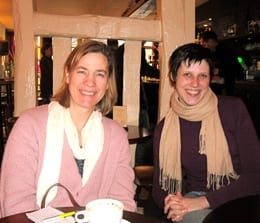
C. O'Brien and H. Bury, in Rennes

I’m particularly grateful that Hélène was chosen to translate my novel.  In the first place, she has lived in Texas, so her command of American English allows her to grasp the subtleties of connotations in the original text.  Consider, for instance, how “slender,” “thin” and “skinny” are all versions of the same concept but convey very different meanings.  “Finish” and “terminate,” are literally close, but one seems far more violent.  In a similar vein, when I have characters say something sarcastic, I choose words that will make that clear to an American reader without having to add a clumsy “he said sarcastically” in the tag.  I also pick certain words because of how they convey a character’s education or attitude, so the language in dialogue is especially important to me.  There are layers, too.  If Leon is described as “dreamy,” the word sounds sort of cute and dated, yet when a teen says it in a teasing way, it adds a quick sting of humor.

Hélène made thousands of word choices to accurately translate Gaia’s story into French, but there’s another factor I hadn’t considered.  She explained that sometimes one word in English would need three words in French to translate accurately, and it simply couldn’t be done with any artfulness, so something got lost.  Conversely, there were other places where a literal translation was possible, but there was a more graceful way to say the same thing in French.  In those cases, because she’d had to drop out a certain element in one place, she tried to add it back in where she could.  She knew what would sound smooth and polished in French, knowing that was what I valued in my English.

It’s very clear to me that my book was entirely in Hélène’s hands, and that translation is another form of writing, really–an art in itself.  In her effort to do the best job she could, Hélène asked her parents to read her translation to check for clarity or confusion, which is exactly the sort of thing I would do (Merci à vous, les parents!).  To my delight, she and her parents invented a verb “Gaïater” that means “to work on the translation of Gaia’s story” because that’s what Hélène was doing so intensely for so long.  (Bonjour, Hélène.  Qu’est-ce que tu fais ce soir?  Je Gaïate.)

Finally, there’s another reason why I’m glad Hélène was the one who translated Gaia’s story.  She gets Gaia.  For me to sense a kindred spirit in Hélène so quickly, I believe we share some of the same sort of vulnerability and strength, the outsider-ness and longing that underscore Gaia’s own character.  This translation wasn’t only an intellectual exercise, but a work from the heart, too, and that pleases me enormously.

I’d like to add that of course the translation also depended upon my wonderful French editor Sarah Millet for even more fine-tuning, just as it went through many versions of editing in the original American English.  Birth Marked Rebelle is really a book in its own right, another team effort.  I’ve been reading it while I’m here in France, skipping ahead to my favorite sections, and je dois dire, it makes me très heureuse.

Behind the Scenes: From Copyedits to First Pass Pages

After I finished going through the copyedits of Prized, I emailed the manuscript back to my editor Nancy Mercado at Roaring Brook in mid-December.  The next step was a series of emails we had in early January, when Nan checked back with me about a few of my changes and other things she’d noticed, like whether a character would be called by his first or last name in a particular line of dialogue.  Here’s another example, with my reply in italics:

Pg 153 “She might be too polite to say anything, but she was far from blind.” This isn’t part of Dinah’s dialogue, is it? Just checking. You just mean add this to the line, yes? Yes.  It is NOT dialogue, but just a comment on her thinking, and it goes on the same line as Gaia’s “indeed” line because it’s Gaia’s reaction.

All writing, revising, editing, and copyediting were finished, and at that point, Nan told me the book was heading off to layout—a significant milestone.  That was when the manuscript would be transformed from a Word document to pages that actually looked like a book.

Most of the design work didn’t involve me, understandably.  However, anytime I included an image, like hand-writing or a freckle pattern or a map, it was a design issue where my input was considered.  Like Birthmarked, Prized also has a code in it (why not, right?) and for the original manuscript, I drew the code, took photos of it, and dropped the photos in the document where I needed them.  They were basically place-holder images, but once designer April Ward was considering the look of the page, I rewrote the code again, took more photos, sent them in, and conferred with Nan about which images we actually needed.  By early February, Nan forwarded a file to me of how the thirteen pages with specific design issues would look.  They seemed gorgeous to me, frankly.  By the time April finished refining, even a certain shadow was perfectly aligned.  It’s the sort of thing that delights me, and  I am deeply grateful for April’s beautiful work.

First Pass Pages for Prized

This week, Nan sent me the first pass pages for Prized, with each page laid out exactly as it will be printed in the final book.  Now is my chance to read through it one last time for any changes I can’t live without.  It’s like the dress rehearsal.  I have several weeks until the deadline, and I’ll need the time to read as carefully as I intend to, hopefully twice.

Though I’ve reread parts of Prized while I’ve been working on Book 3, sometimes to check a detail and sometimes because I just like being with friends in favorite scenes there, I haven’t read through the entire story since December, so I should have fresh eyes for the job.  I’ve never read the story on paper at all, and that makes it new for me, too.

And so you find me today at the dining room table, armed with a new pen, and I’ve started going through my first pass pages of Prized.  The first chapter looks clean to me, and I’ve made only a few tiny changes, so I’m optimistic this part of the process will go smoothly, especially since I’m eager to get back to revising Book 3.  Nan and a proofreader are going through these pages, too, and between the three of us, here’s hoping we catch anything monstrous.

Behind the Scenes: Copyedits

I received my copyedits for Prized two weeks ago, along with marginalia from my editor.
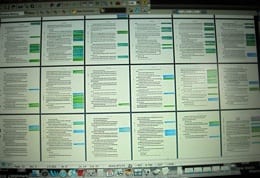
A.Copyedits and Marginalia

We work with the Track Changes feature of Word at this point, and when I first received the manuscript, I shrank down the pages to get a general idea of how many comments I’d be dealing with (see Photo A).  The purple comments from Jill Freshney, the managing editor, have to do with formatting, so I largely ignore those. The green ones are from Suzette Costello, the copyeditor who, incidentally, also did the copyediting for Birthmarked and remembers things like Gaia’s customary gesture with her hair and points out where she’d be likely to do it again.  Amazing.  Suzette catches things like when I turn a cloak into a shawl, put a space in “anymore,” mix up the names of players on my teams, or say “boys turn into girls” when I really mean “girls turn into boys.”  She’s a mind reader with a very precise eye.  Her suggestions take little soul searching for me, and I almost always accept them.

B. Notes Up Close

The aqua comments are from Nan Mercado, my editor, and these are substantive. Though Nan and I have been discussing drafts of the novel since March, this is the first chance we’ve had for line-by-line feedback, and reading her notes in the margins is like having an extra voice along in my mind while I’m writing, a friend who pauses to call attention when anything could be clearer. She might say, “This line seems slightly out of character for the narration, no? It’s a direct statement about how Gaia is, instead of her state of mind at the moment,” or “I like how this will be echoed later in the scene with cadaver, but I’m not sure I believe that she would examine a corpse in this moment. She was so weak, why would that occur to her?” They tend to be open-ended questions that I could solve in any number of ways, and there are very few I disregard. Even then, I consider carefully before I make no change.

As I go, I keep in mind the broader comments Nan included in her accompanying letter, with feedback from her intern, too. Stacy Herman hasn’t read Birthmarked, so her fresh perspective helps me think about what might be missing for readers who come to Prized having no familiarity with the back-story.  Explaining old business requires a delicate balance because I dread boring returning readers with repetition, but I don’t want new readers lost.

The last thing I consider is another draft of my own that I kept revising while the book was ostensibly out of my hands. You can see it in the background of the screen (see Photo B). That tinkering gets merged into this draft, too, and I need to make sure it is scrupulously clean because the book is now post-copyedits. How awful it would be to throw in extra errors at this point.

C. After Folding in Copyedits, etc.


Here’s what the manuscript looks like once I’ve made my changes (see Photo C).  You maybe can’t see it, but the red indicates new changes in the text, and I deleted the comments from the margins as I went, leaving only a few that I’m still pondering.  I have about sixty pages left to go, so I’ll be done in a couple days, but I’d like to take one more chance to read through the whole thing at normal speed, just to make sure it all works.

In case you can’t tell: I love this part of the process.  I could not do it without Jill, Suzette, Nan and Stacy.  Never think my novel is the work of one person.

Behind the Scenes: A Query Letter

In May, 2008, I wrote to three dozen literary agents to see if any of them would be interested in taking on Birthmarked, then called The Baby Quota.  Here’s my initial email correspondence with Kirby Kim, who now represents me.

Dear Mr. Kim:

In a dystopian future, the world is divided between those who live inside the wall, and those, like sixteen-year-old midwife Gaia Stone, who live outside.  It’s Gaia’s job to turn over her quota of infants to the authorities within the wall, until the night one agonized mother objects, and Gaia’s own mother disappears.  Fraught with difficult choices that propel Gaia further and further within the confines of the wall, to the prison and even to the Bastion where the Protectorate lives with his privileged family, THE BABY QUOTA is the riveting story of a girl who wants to save her mother, and a society where a criminal is defined by her genes.

THE BABY QUOTA is an edgy young adult novel of 70,000 words, suitable for mature high school readers.  I understand that you represent young adult fiction, and I believe my novel has the intensity that would appeal to readers who enjoy the works of Ray Bradbury and Laurie Halse Anderson. 

Since I earned my MA in the Writing Seminars at Johns Hopkins University, I have published six category romance novels with Silhouette, Bantam, Avalon, and Kensington.  I have also published a handful of parenting articles for The Hartford Courant.  Though I’m on leave this semester, I normally teach at Tolland High School, in Connecticut, where teenagers are a daily part of my life, and I have three teenage children of my own. THE BABY QUOTA is my first young adult novel.

I’m including a brief summary of the novel below.  If you would care to see the complete manuscript, please let me know.  Thank you in advance for your consideration of my project, and I look forward to hearing from you.

Sincerely,

Caragh M. O’Brien

Yosemite, June 2008

That’s cute about Bradbury and Anderson, right?  How often do you see those two authors in the same sentence?  Kirby must have thought I was something else.  He replied the next day in what I would later discover was his typical timeliness.

Hi Caragh,

This sounds very interesting. Although I just sold something similar I’d be interested in taking a look. Please attach to an email at your earliest convenience.

Best,

Kirby Kim

By June, when my family was driving back to Connecticut via Yosemite, I had four offers of representation and began to believe my novel might have a chance of being published.

Audio Books
The audio books of BIRTHMARKED, PRIZED, and PROMISED have been released by Tantor Audio. They're available through Tantor, Barnes & Noble, Amazon, and Audible.com
Blogger Roadsign