Archive for July 2011
Note to Self: It’s Not the Plot
I swear I’ve been here before.
I’m working with this draft of Book 3, and I’ve been revising along pretty steadily from the beginning, knocking out characters and scenes, deepening what remains, and I’ve reached a place where Gaia gets out of trouble. She can catch her breath for a minute, which is obviously a disaster as far as writing goes. The two of us sit back and look ahead at the next few scenes, and the links between them are simply not there. In fact, all of the rest of the book appears to have a random quality. The scenes make sense within themselves. Some are quite convincingly grueling, even. But the underlying threads to keep them all together are not tight.
I think this is what my editor observed when she advised me to consider Gaia’s motivation in this book. I know what her motivation is. At heart, it is “fight evil.” But that isn’t enough.
This is what I’ve realized just now, and it’s connected to “Nothing’s Going to Harm You” from Sweeney Todd which I listened to while I was stationary biking this morning. I don’t like that musical. I couldn’t even watch the movie. But the song has haunted me since I first heard it years ago, and when I listen to it now, I find its peculiar combination of sweetness and menace so disturbing. I think, the man who wrote that song and that musical was willing to go to some very, very creepy places in his mind.
That’s where I want to go. Not, of course, into Sondheim’s mind, but into my own dark, squeamish corners. That’s where I need to go for Book 3. My problem is not the plot. I can’t solve this book by lining up the events and bolstering the connections between them. I need to push deeper into the characters and find out how I can hurt them psychologically. I have to find the costs there.
Ick, right?
I don’t have my solutions yet, but I know where to go looking for them now. This is not going to be a fast fix.
Playing Death at the Lake
The gutsiest thing I ever did at the lake nearly killed me. The color of our family’s lake in Minnesota, where four generations of Geist-O’Brien-Walshes have happily cavorted for as many decades, is a deep, rich brown. Rumor has it iron turns the water that color, while other theories lean toward peat, but whatever the reason, the result is unlike any lake color I’ve ever known elsewhere. The water feels extra heavy in your palm, too, and it’s deceptively easy to float on. It’s like swimming in cool coffee, but with a pure, clean smell, where no moldy, putrid slime can grow.
Half a foot down, your hand looks golden brown. A foot down, you can hardly see it at all. Wade three feet in, and you can’t see your toes. When I was a teenager, I was scared of the darkness of the water, even though I swam in it daily. I could not tell how deep the water was, nor what might be swimming down there ready to gnaw off my ankles. I was especially uneasy out by the floating raft where I routinely swam with my siblings and cousins, so I learned to swim near the very top surface of the lake, never letting my legs shift vertically to the cooler water below.
One day, I decided to overcome my fear once and for all. I decided to go down to the bottom. I was accustomed to the swimming pool at a club in the city where I could propel myself downward, feet-first, knowing that no matter how deep it was, I could bounce off the concrete at the bottom and shoot back effortlessly to the surface. So I imagined I would do the same thing in the dark water, touching down against a hidden sandy surface. I would finally know how deep it was and know that nothing could harm me.
So I took a big breath, pointed my toes, and started down cautiously. It was colder there, and I looked back up through the water to the sky rippling above, while water gurgled in my ears and my bubbles rushed upward. My feet touched no bottom, so I swam back up into the air to breathe. The bottom, I’d learned, must be farther down and it would take some effort to get there.
I took another big breath, and this time I used my arms in serious reverse, pushing the water upward to plunge myself down as far as I could go. When still there was no bottom, I prepared my hands for another plunge and shoved myself downward as hard and fast as I could. My feet drove into mud as thick and clinging as wet cement. Instead of bouncing like a drumstick off a hard, sandy bottom, I was stuck up to my knees in black, viscous goo.
Up above me, the sky was a tiny speck of lukewarm light in a wash of black, and I was running out of breath. I scrambled, trying to heave myself out with frantic pulls at the cold water until one of my feet came free. I kicked and lunged upward, sucking my other foot free, and then I began to swim upward toward the light. My lungs were exploding, so I began to exhale through my lips, hitching hard in my throat, knowing once my air was gone there’d be nothing but water to gulp in unless I reached the surface, which was still impossibly far above me.
My heart surged in pain. Nobody knew where I was to help me. I’d made no announcement before I went under. The water was so dark that my cousins on the floating dock only twenty feet away had no idea where I was or that I needed them. Anxious and terrified, I swam for all I was worth, straining for my life, kicking and fighting toward the top, and when all my air had bubbled away into the black water, I clenched my throat closed to seal my oxygen-starved lungs, struggling not to inhale the lake.
The surface was larger now, an uneven circle reflecting silvery, indifferent saucers of light, but I was still several feet below. I kicked and pulled one more desperate time and broke into the air. I gasped, finally, sucking in huge lungfuls of thin, clear air, and stared around me.
My cousins were still sitting cross-legged on the floating dock, laughing, swatting at black flies. The aunts were back on shore in their lounge chairs. The sky, overhead, was an uneventful blue. My ears were rushing from inside, but outside my head, the surface of the water was peaceful and lightly rippled, calm and silent. Still terrified, I was also stunned with gratitude.
I have not gone back down to the bottom of the lake. We just had our annual reunion there in northern Minnesota. I’ve told my children and all my nieces and nephews of my story so they know not to do what I did. The water is as dark as ever. My teenage son told me he swam down there, but slowly. He said it’s not too deep. He said I don’t need to be afraid. But I still am.
Company
Things happen when company comes. In the last two days, warning lights appeared on the dashboard of the car, the electricity spontaneously stopped working on one side of the house, and I lost my cell phone. These events were purely coincidental and in no way caused by my lovely college friend’s arrival, but having a witness did make me a bit more aware of how I handle things.
We don’t get thrown much by the little stuff here. I looked up the warning lights and dropped the car at the garage, tried the fuse breakers and ran orange extension cords to two bedrooms, and eventually found the cell phone under the couch.
I also had the pleasure of walking a hilltop at sunset with my friend, making lemonade from scratch, touring the Mark Twain House, and seeing Harry Potter 7.2 in a theater full of fans.
I like surfacing from my revisions now and then to see what’s up in the real world. Now I’m going back under.
How Do the Bugs Get In?

One summer, fine green
grasshoppers came in pairs to linger
on my bedroom ceiling.
A two-inch-long stag beetle
crawled behind the garbage can
the other day.
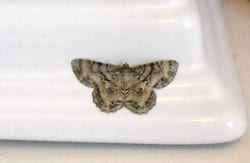
This morning there’s a moth
on the sink pedestal.
I suppose the bugs fly unnoticed
in the door’s gap when we’re passing
out and in all day long, but
it does seem strange when
unusually large ones appear
unannounced, most often
when we’re barefoot
and vulnerable in the bathroom.
I do nothing about them but
marvel and wait
‘til they die, when I collect
each frail carcass in a tissue
and throw it away.
Head People and Pie
Lately, a fellow writer friend* asked me enviously if I’m one of those writers who has characters in my head demanding attention. He said his characters were more likely to tell him to go watch TV and leave them alone. It was the envy that surprised me. It implied that writing is easier when you’re possessed by voices, like you’re just a crazy person getting paid for yielding to your psychosis.
It’s not like that. Here’s what it’s like for me. I have a character who just had a hand injury and lost a digit of his finger. He needed medical attention but he was in a primitive situation, so I pictured a cauterization with the heated surface of an old-fashioned, cast-iron iron. Clumsy. Painful. Not quite right. I did some internet research about cauterizing wounds and went to bed. The next morning, I’m awakened by pain in my left hand, vicarious, empathetic pain that runs as tension all the way up my arm, and I stir enough to realize my character can’t be left as he is. He’s hurting.
So I get up and keep revising to fix his finger.

Blueberry Pie
I don’t understand where characters come from, or how they can become so distinct and real to me. While I’m writing, I’m surprised by what they say and do, of course, but it doesn’t end there. When I’m not writing, when, say, I’m washing dishes at the sink, I feel them in me, like I can feel my dad in me even though he’s been dead these three years now, or like I can summon the affection I had for my sixth grade teacher even without resurrecting a specific memory of her. I especially feel my characters in me when they’re in an unresolved situation. It bothers me, the way it bothers me when I have a misunderstanding with a friend, or when a stranger yells something crude at me from a passing car and I have no idea why.
The nice thing about characters is that I can fix their problems. I can take them to resolution or deliberately decide not to. The people in my real life are beyond my control. I can’t erase the injustices they face, or force them to rethink their flaws. Maybe that’s why I value having my head people, too, for the fictional closure they provide, for the way I can encapsulate them and keep them forever just as I like them.
Yesterday for a perfect holiday, I wrote to windchimes on the back porch, hung out with my family, walked in the forest, and baked pie.
* Okay, it was Tommy Greenwald.