Posts Tagged ‘birthmarked’
Profanity: the Gateway to Evil in YA Lit?
I’m all for profanity in books when it suits the characters and the situation. Most of the teens I know employ a range of swear words and use them flexibly for humor, sarcasm, and rage in real life, so when I encounter teens in books who use obscenities, it doesn’t faze me much. It seems real.

So why don’t I use obscenities in the Birthmarked trilogy, and isn’t it inconsistent to be prudish about language when I’m writing about edgy concepts, like childbirth, hanging pregnant women, torture, murder, and abortion?
It makes me wonder how often we mentally lump together foul language with adult concepts. We presume a book with swear words is likely to contain sexual or violent content or both. Since a film can be rated PG-13 due to its language, sexual content or violence, we’re conditioned to assume the three go together and all are equally objectionable for impressionable minds. We assume someone is “mature” only after they can handle all three.
But guess what? I happen to like books that deal with edgy concepts and for my purposes, it works better artistically to write about them without profanity. My trilogy is in third person, and it is futuristic rather than contemporary, so I don’t have the challenge of trying to create a believable interior voice of a teenager today. In the dialogue, my teen characters have a degree of formality that fits the oppressive society that governs them. As they get to know and trust each other, their language relaxes, too, and I liked playing with that.
From a practical standpoint, I happen to use swear words sparingly in my own life, so I didn’t have to cut back much for the book, but there were definitely places when a character could have naturally said “Oh, my God!” In those cases, I deliberately edited to avoid even that mild curse, because, in fact, the societies in my novels are so devoid of traditional religions that the characters never mention God.
Curiously, I think the lack of obscenity is allowing my work to fly under the radar of some parents who use the degree of profanity as a guideline for what is acceptable for their kids to read, especially for younger readers. Such parents may hope to protect their kids by preventing them from reading books with obscene language, as if profanity were the gateway to worse evils. I have personally watched a mother flip through a novel, searching for “s—” and “f—” to rule out the book as a gift for her young daughter, yet my books would pass her test, and the girl would inadvertently be exposed to some intense passages. Other readers have mentioned a distinct preference for no obscenity. In fact, this blog was inspired in part by one who recently wrote to me: “Also thank you so much for not ruining your story with profanity. I hate reading a book with a good plot but lots of language because I have to stop reading it.”
I guess I’m glad my book without profanity isn’t being rejected by readers who don’t like swear words, if you can follow my logic of negatives. A little subversive side of me wonders if I’m sneaking evil to them in the guise of a clean read. Yet I’m also wary, because I think the 12+ rating of my books is actually an invitation to advanced readers as young as 10, and I’d be careful of which kids that young are mature enough for the concepts. Most of all, I’m interested in this place where profanity and edgy concepts diverge. I’m intrigued when we can use civil language to encounter and discuss horrific ideas. I love that this can happen in YA literature.
Sweet Deal
For a limited time, the e-book of Birthmarked is available for $2.99 on Amazon. I don’t think I can take credit for this idea, but I am all for it. It’s almost as good as going to the library to take it out for free!
Do I have a Kindle? I do.
Do I prefer to read paper books? I do. Except when I’m traveling, or when it’s the middle of the night and I need a book now.
Birthmarked Is Out in Paperback
(These remarks are cross-posted on the MacKids site.)
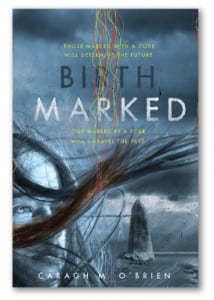
The moment of Birthmarked’s paperback release gives me a portal into a little time travel. It invites me to leap forward because, for any readers who are about to discover Gaia’s story, the paperback is now the real thing. This is the gritty version you’ll read at the beach or squish at the bottom of your backpack, while the hardcover will shortly become a quaint artifact from an earlier time, a sturdy tome you might find on your older cousin’s bookshelf or sleeved in plastic at the library. As more time passes, and other books in the series come out and aunts discover them for birthday gifts, I predict the stories will be identified by their matching covers, the new ones with the cool script and evocative, object-based pictures, while the lone hardcover of Birthmarked with the windswept girl on the cover will seem more and more like an orphan. Such is the view from the future.
If I take the portal back twenty months, that orphan was the real book, the only book. The hardcover is the one I’ve held when giving readings, the one I’ve signed and wrapped for gifts. I had no idea that I would hear from readers about how much they loved Gaia with her feisty determination, or how anxious they were about troubled, changing Leon. I hoped but didn’t fully expect that those readers would tell their friends, mothers and grandfathers about my novel. They have. In time, Birthmarked has been honored by YALSA, the Amelia Bloomer List, and the Junior Library Guild, and by state reading lists in Rhode Island, Georgia, Utah, Texas, and Arkansas. My novel is read overseas in five countries and counting. I’ve found that people seem to genuinely enjoy Gaia’s story, and I’m incredibly grateful.
When I bring the portal back to focus on this moment, this paperback seems like a slim, sophisticated little sister, full of promise. I like how the page numbers match the hardcover’s so I can still find my favorite image on page 200, and I like the extras at the back with the unassuming photos and the opening scene from Prized. I even like the timing, with this paperback appearing on the brink of the release of Prized, Gaia’s continuing story, which is about to materialize into its own corporeal form. For now, I can look up from my computer and be excited.
So, thanks to my kind readers for leading Roaring Brook to believe there’s a readership for this series, thanks to April Ward at Macmillan and Tim Green of Faceout Studio for the smashing new cover, and thanks to Jessica Tedder and Anna Booth for tireless help in creating the bonus extras for the back matter. Birthmarked in paperback would not have happened without you. Thanks!
All best,
Caragh
The Missing, the Lost, and the Stolen
Now and then, when I’m taking a quick break from writing, I go to WorldCat.org, the free website that catalogues books in libraries worldwide, to see if anybody’s reading my book. Birthmarked is listed in 720 libraries. That seems like a lot to me. For a frame of reference, Harry Potter I (1998) is in 5,021 libraries, and Printz-winning Paolo Bacigalupi’s Ship Breaker (2010) is in 1625.
One amusing thing about the site is that it organizes the libraries by distance from my own zip code, so the system farthest away that carries my book is, at 10,400 miles, the Sutherland Shire Libraries in Australia. I get a kick out of that.
For no particularly logical reason, I’ve picked one library system to be my litmus test of whether anyone’s reading my book, and that’s the New York Public Library, which lists fourteen copies in eleven different locations, from Battery Park YA Fiction to Yorkville YA Fiction. If even one copy of Birthmarked is checked out, I feel like I’ve scored. Sometimes it’s as many as six.
This weekend, I found something new when I checked the site. A copy has gone missing. MISSING! Maybe it’s just sincerely lost, but maybe MISSING is a euphemism for STOLEN! I’m imagining some reader liked Gaia’s story so much she stole it, hiding the hardcover furtively under her black jacket as she slunk out of the library and down the marble steps into the rain.
It’s sort of a compliment, but only sort of. The problem is, now that my book is stolen, nobody else gets to read it. The poor frazzled librarians with their dismal budgets can’t replace it, so the book will remain listed forever as missing, or maybe the entry will end up deleted. In the meantime, once read, the book will molder under the thief’s bed, with cookie crumbs and other stolen books, sadly wishing it were back on its old shelf beside Day of the Assassins by O’Brien, Johnny (unless that’s gone missing, too).
My friend Kay Cassidy, who runs the Great Scavenger Hunt Contest™ for over 700 libraries nationwide, recently advised me not to sign the copy of Birthmarked I sent along for one of the prize packs that she awards to librarians. Kay said that signed copies are more likely to walk. In short, making a book special defeats the purpose of donating it. Sad, right?
Now I’m imagining the scope of hundreds of books all stolen away. The police blotter from Shaker Heights, OH recently posted that $12,000 worth of books were stolen over a seven-year period from two libraries there. We can start multiplying.
It’s too awful to bear, frankly. So instead, I’m hoping MISSING really just means “momentarily misplaced,” like what happens with my keys upon occasion, and the book will show up soon, abashed perhaps for having let itself fall down a crack behind some other book for a day or two. I’m picturing it getting a little dusting off and a quick shove back into place, ready for the next hungry patron.
Sometimes optimism is all we have. Optimism and libraries.
*Edited to Add: As of today, 4/21, the MISSING listing has been changed to DUE 5-11-11, so the book has been found!
Cover Reveal: Prized (Birthmarked #2)
Take a look!
Here’s the cover of Prized, the sequel to Birthmarked, which is due out November 8, 2011. April Ward at Macmillan worked with Tim Green of faceout studio on the design, which I think is fantastic. If it seems like a departure from the first book in the series, take a look at what has been done for the paperback of Birthmarked, due out in October.
Pretty sweet, huh?
Behind the Scenes: A Note on the French Translation
My daughter and I met Hélène Bury, the French translator of Birthmarked, in front of the Hôtel de Ville in Rennes at 10:00 Saturday morning and instantly bonded. Hélène is funny, smiley, and genuinely nice, and what’s more, she and I have certain things in common that sealed our friendship: we both prefer hot chocolate to coffee and adore Colin Firth.

C. O'Brien and H. Bury, in Rennes
I’m particularly grateful that Hélène was chosen to translate my novel. In the first place, she has lived in Texas, so her command of American English allows her to grasp the subtleties of connotations in the original text. Consider, for instance, how “slender,” “thin” and “skinny” are all versions of the same concept but convey very different meanings. “Finish” and “terminate,” are literally close, but one seems far more violent. In a similar vein, when I have characters say something sarcastic, I choose words that will make that clear to an American reader without having to add a clumsy “he said sarcastically” in the tag. I also pick certain words because of how they convey a character’s education or attitude, so the language in dialogue is especially important to me. There are layers, too. If Leon is described as “dreamy,” the word sounds sort of cute and dated, yet when a teen says it in a teasing way, it adds a quick sting of humor.
Hélène made thousands of word choices to accurately translate Gaia’s story into French, but there’s another factor I hadn’t considered. She explained that sometimes one word in English would need three words in French to translate accurately, and it simply couldn’t be done with any artfulness, so something got lost. Conversely, there were other places where a literal translation was possible, but there was a more graceful way to say the same thing in French. In those cases, because she’d had to drop out a certain element in one place, she tried to add it back in where she could. She knew what would sound smooth and polished in French, knowing that was what I valued in my English.
It’s very clear to me that my book was entirely in Hélène’s hands, and that translation is another form of writing, really–an art in itself. In her effort to do the best job she could, Hélène asked her parents to read her translation to check for clarity or confusion, which is exactly the sort of thing I would do (Merci à vous, les parents!). To my delight, she and her parents invented a verb “Gaïater” that means “to work on the translation of Gaia’s story” because that’s what Hélène was doing so intensely for so long. (Bonjour, Hélène. Qu’est-ce que tu fais ce soir? Je Gaïate.)
Finally, there’s another reason why I’m glad Hélène was the one who translated Gaia’s story. She gets Gaia. For me to sense a kindred spirit in Hélène so quickly, I believe we share some of the same sort of vulnerability and strength, the outsider-ness and longing that underscore Gaia’s own character. This translation wasn’t only an intellectual exercise, but a work from the heart, too, and that pleases me enormously.
I’d like to add that of course the translation also depended upon my wonderful French editor Sarah Millet for even more fine-tuning, just as it went through many versions of editing in the original American English. Birth Marked Rebelle is really a book in its own right, another team effort. I’ve been reading it while I’m here in France, skipping ahead to my favorite sections, and je dois dire, it makes me très heureuse.
Facebook, Amigas, and a Foreign Rights Deal
Thanks to the Internet, I’ve become friends with Eva Rubio, a university student in Salamanca, Spain, who blogged enthusiastically about Birthmarked last summer. Eva was determined for Birthmarked to be translated into Spanish, so she and her friend Rocío Muñoz started a Facebook page aptly named Queremos que Birthmarked de Caragh M. O’Brien sea publicado en España and started collecting followers. I thought they were unbelievably nice, but I didn’t hold out much hope.
When my family made plans to visit Salamanca last summer, Eva and I realized we could meet in person. I was beyond excited. Not even my lack of Spanish could deter me. Curiously, Eva’s grasp of written English was so good that she could read my entire novel effortlessly, but she couldn’t understand spoken English or speak it any better than I could understand or speak Spanish, so she brought along a couple friends, Cris and Leticia, and Leticia interpreted for us. I brought along my college-aged daughter, and the five of us strolled around the midieval quarter and Calle del Toro, visiting boutique bookstores and window shopping. We laughed a lot. We bonded. We were friends.
In our last moments together, we shot a tiny movie of Eva and me together in the incredibly beautiful, lively Plaza Mayor. The whole thing was sweet and goofy beyond belief.
Within a few weeks of its initiation, the Spanish Facebook page had more members than my American Facebook page had gained in months, and when I spoke to my agent shortly after my trip to Spain, four Spanish publishers had contacted him about foreign rights. That was June. A month later, my agent told me we had an offer from Grupo Everest. I could hardly believe it.
Along the way, the original Spanish Facebook page lost its administrators, but Eva and Rocío started a second one. They were unstoppable. One of their friends created a Spanish book trailer, and others found photos of actors (one quite caliente, I must admit) who resembled the characters. They linked to other reviews, signings, a giveaway, music, and basically lived it up about Gaia’s story. I could hardly make sense of the Spanish, but it was definitely silly and fun.
When I heard the news that the deal with Everest was final, I asked Eva to be the one to announce it, which she did on her website and on Facebook last week. Now it’s for real: Birthmarked will be published in Spain this fall.
It’s all thanks to Eva and Rocío, and the sweeping reach of Facebook. Gracias, mis amigas! Gaia sends her love.
French Dreams

Birthmarked in France, February 11
J’ai oublié presque tous ce que j’ai appris quand j’étais une étudiante à Paris il y a plusieurs décennies, mais parfois même maintenant je rêve en français et sens le mélange de l’échappement d’autobus, du pain, et des arbres d’eucalyptus sous la pluie. Maintenant, ma fille est une étudiante à Rennes, la même ville où Helène Bury la traductrice de Birthmarked vit. Nous allons prendre le café ensemble, nous trois, quand je visite la France en mars.
L’édition de mon livre en français sera publiée demain. C’est un monde curieux, je pense.