Archive for February 2012
The Last Map
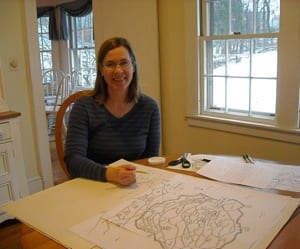
I put the final touches on the map for Promised last week. It’s funny, because on paper it doesn’t look like I did much, but the thought process and the designing were actually rather involved. I began with the original, oversized map from Birthmarked and took a trip down to Staples to make 11×18” copies of it in pieces to tape together. The taping part reminded me of grade school, when I first delighted in matching up edges so lines across ripped pages looked continuous, healed.
Then I went to the attic to find the big paper I knew was up there somewhere, a process that involved culling out a couple old games and rearranging a bookshelf while I was up there. Naturally, I had to face my mortality through my dread of properly cleaning my attic before I die (decades from now) so that my children won’t be saddled with my nonsense and secrets. Attics are never simple.
At last, seated at the dining room table with freshly sharpened pencils, I realized I’d been thinking about this map for months. I had already envisioned the terrain where Gaia walked, and where a refugee community would pitch its tents. As I began drawing, snaking off a path line of the original Birthmarked map, I realized I was doing something Gaia could do if she drew a map from memory, for planning purposes. I could feel the double-shadow of her fictional hand clasping the same pencil I did.
The paths expanded and wove together. I named locations, added labels, and made a note to myself to include a change to Promised when it comes back to me in first pass pages. I slept on my ideas, took another look at my draft, and revised. I made mistakes, used a white-out pen, and when my lines became too garbled, I substituted in another one of the 11×18” copies I’d made and started a section over.
The final map, as I’ve said, might not look like I changed much from the one in Birthmarked. Yet this map is exactly what is needed for Promised, no more and no less. I’ve sent it off to Macmillan, and now it’s up to Anne Diebel, the art director, to find a way to put my pencil scratches into the book.
Cover Reveal: Promised
We have the final cover for Promised!
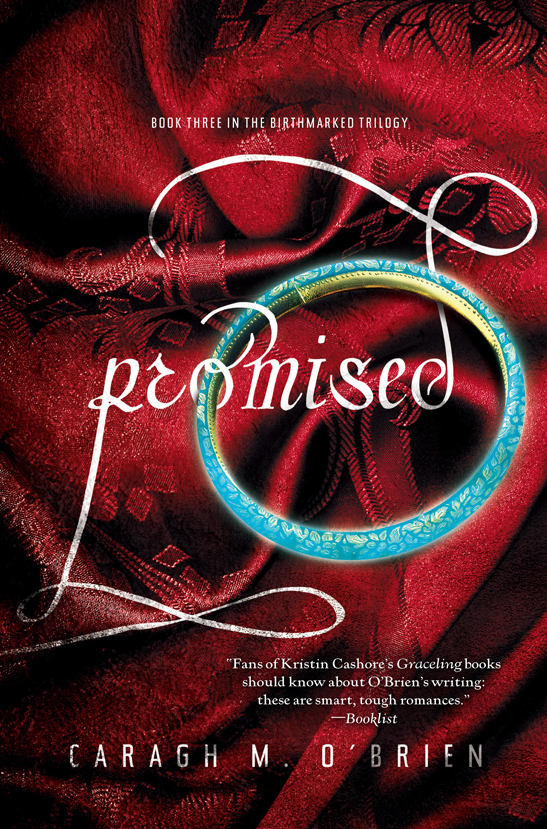
Luscious, if you ask me. I have a thing for bright, bold book covers, so I’m thrilled about the red and the way the bracelet zings forward against the fabric background. I love the continuation of the distinctive, lyrical Trinculo font from the first two books in the series, too. Tim Green of faceoutstudio designed this cover, as he did the paperback of Birthmarked (Book 1) and the hardcover of Prized (Book 2).
Book 1
I believe a cover should invite a reader in visually, and create a vibrant initial impression upon which the novel expands. Ideally, the cover art and novel should not only match, but add to each other, so that by the time a reader has become wrapped up in the story, she also feels like she has been wrapped inside the cover. Forever after, the story and the cover art should be inextricably meshed.
In the case of Promised, I was still revising while we were designing the cover, and my editor and I discussed possible objects from the story that could serve as focal points, the way the ribbon and the monocle were visually appealing and symbolically resonant for the Birthmarked and Prized covers. My draft of Promised had a significant anklet and a blue ribbon worked into the sleeve of a dress, and as I pondered them more, I discovered they would work better combined into a bracelet.

Book 2
I came up with a description of a bracelet with many glowing bands and filigree, and my editor sent that along to faceout. When Tim Green sent back an image of a single band, with the exact glow and filigree I’d imagined, I was mesmerized. From then on, I adjusted the description in the book to match the bracelet, and that’s what is used on the cover.
It was satisfying and fascinating to collaborate on ideas for this cover. Normally, cover artists work from the text of a completed book to come up with their cover designs. In our case, the cover artist and I sent text and images back and forth, and I was able to work from the draft images of the cover to revise my novel. How cool is that?
In case you’re wondering, Promised is due out on October 2, 2012.
Gaia in Deutsch
I visited Germany with my husband in October, 2010, and when jetlag woke me in the middle of the night, I worked on revising Prized. Today the German version of the novel, Das Land der verlorenen Träume (The Land of Lost Dreams), is released in Germany. While I enjoyed visiting Cologne, Bonn, and Trier, what I liked most was the Mosel Valley, with its quaint villages and neighboring castles. I can hardly be the first tourist to say so.
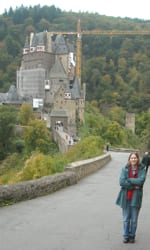
Happy American at Burg Eltz
I’m thankful that my first novel, Die Stadt der verschwundenen Kinder (The City of Missing Children), has been warmly received by readers in Germany, and I hope they enjoy the continuation of Gaia’s story.
Let me offer my thanks once more to Oliver Plaschka, my translator, for his painstaking work. My novel is much longer in German than it is English, so I fear it was a monstrous job.
Q. When Did You Start Writing?
A. Seventh grade. Didn’t everything start in seventh grade? I had no idea then which assignments might turn into habits or which habits would turn into life-long pursuits. If you had asked me, I might have told you I loved playing violin and drawing more than writing. True, I woke up early to read books before school, but I also enjoyed being in the school’s musicals. It was a big deal when our class had a roller skating party, and I proved a lot of math theorems, like the other seventh graders. I was often busy tending my two-year-old sister, whom I adored. We would sled until nightfall. Afterward, I might write a poem about the color of the snow, but I think everyone probably did.
I doubt there was any special clue then that ages later I’d be lying on my couch, writing books. It certainly didn’t occur to me to be a writer. Mr. Sanborn passed out a pile of gray-blue journals and told us to fill a certain number of pages weekly, and he checked. That was all. Yet when I filled my journal, he gave me another and I filled that one, too. I’d discovered something that mattered to me, something about telling secrets to myself, and over the years, writing and thinking became the same thing.
These days I have two journals, one by my bedside where I add a few lines about the day each night before I go to sleep, and one on my computer where I go off at length whenever the urge strikes. I seldom go back to read what I’ve written. That’s not the point. I write in my journal because, at the moment, it creates sense out of my world, and it invariable leaves me saner and more grounded than when I began. I like doing it.
It’s worth remembering that not all writing has to be directed toward a deadline. It need not all earn credit, meet a quota, or get driven into a chute like prep for the CAPT test our 10th graders will soon be facing. I’m all for paid writing–don’t misunderstand me–but I know full well that the wrong directions, secrets, and lies have value, too. Imagine if we all could write for fun. Oh, wait. We can.
The Shelves Paradox
Why do I have more books than can fit on my shelves? If I want to locate Fahrenheit 451, (which surely I must own), after I look through the main shelves in our library and living room, I also have to check the shelf in my upstairs office, the shelves in my son’s and daughter’s rooms, another bookshelf and three more boxes in the attic, and one box in the basement. Then I check my Kindle, too.
This is not a system. This is a happy meandering through my collection or a bothersome, fruitless task, depending on how urgently I want the book and whether I find it. Include the toss-up of whether I’ll still remember what I’m looking for by the time I find everything else, and it’s quite the party here.
We have a very nice public library in our town that accepts books for its book sales. Knowing this, I occasionally cull books from my shelves and drop them in a box in my closet until it gets too full, and then I move the books in shopping bags to my garage to let them attract leaves for a few weeks before I haul them off.
It tends to be raining each time I take books to the library. Don’t ask me why. Recall that bags disintegrate when wet. I try to scamper with my arms loaded, in a great hurry because my next errand invariably involves meeting someone at the airport or getting to the dump before it closes. It’s a soggy, immodest, pathetic business, especially when I end up pulling certain choice titles out of my donation pile because I can’t bear, after all, to let them go.
Naturally, I have started dreaming of more shelves, but I don’t know where to put them. I also yearn paradoxically for simplicity and self-restraint, as it would please me to have only my very favorite books ready to hand. I want more books, but I also want fewer books. I don’t see a solution, frankly. It is one of the great, unsolvable problems of our time.