Archive for January 2012
Enter the Garden
A new world is expanding in my head on four different levels. I should know this feeling by now, but I still find it very odd because I don’t really understand how it works. You know those freeze-frame sequences of a flower blooming, each petal opening in bright, impossible color before your eyes? First-drafting this new novel feels like that, except I’m in an entire garden of those flowers and I’m blind-folded, finding them by touch.
First, it’s happening in a particular scene, when the voice of the main character is coming alive to me in the way she experiences the room where she is, with the night rain on the skylight just before she climbs through.
As one scene leads to the next, I’m going with her, discovering the community where she lives, with its physical layout and purpose, its friends and enemies.
Beyond that, for the third layer, is the larger world with its weather, political system, wealth, boxcars, century, and connectedness. I don’t even know where my character is on the planet yet, except that she must be closer to the equator than where I live, because of the light.
The fourth level involves layers of time, as my character develops memories of her family and how she came to be where she is. An elusive story is gradually, organically emerging from her and what she does.
Where the novel will actually begin I don’t yet know, because all of these early scenes could end up cut. Shaping the novel will come later, but this is where I begin to know it. It’s so different from the revising I’ve been doing that it hardly feels connected to the same job.
I’m reminded of the computer games I watch over my son’s shoulder, where his avatar marches over a new horizon or into new tiles that come to life only once he’s there, turning green or gray, with battles ready to unfold. The rest of his untraveled screen is black, in the “fog of war.” The difference is, he’s discovering a terrain that the designers created. It exists already, waiting for him.
Nobody knows my new terrain yet, least of all me.
I know people exist who say there are only so many finite plots, and every new story is a permutation of one of those standards, or a combination of them. By the end, by the time my novel is polished, I won’t object if someone says it is this or that, (journey, romance, forbidden love, revenge, Cinderella, initiation, whatever). But I’ll tell you that those standards have nothing to do with my own first-drafting. I don’t start with a template. I go. I discover. It feels both dumb and incredibly powerful.
At least I’ll be surprised. Wish me luck.
Be Brave. Experiment. Dance.
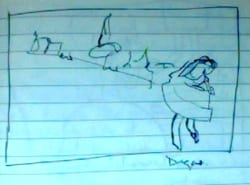
You know Degas? The French artist who painted all those dancers? His ballet dancers are so ubiquitous that I see them more as friendly, familiar wallpaper than as art, and yet when I saw one of his paintings recently, it kept pulling at me, and I wasn’t sure why. I started wondering about the way the main figure was placed so far to the right, leaving so much empty floor space of the dance studio behind her, and then it hit me that the dancer was poised to turn and move into that space. The painting was alive with this strange tension, this potential for movement, and it drew my eye back and forth. The painting made my mind supply the dance.
How cool is that?
I love when I discover something by seeing things in a new way. My favorite artists have weird, playful, or political things popping from their work. Their paintings and sculptures urge me to be brave, to write with conviction, to explore and create.
I’m experimenting with my writing, toying with a new idea in the 12th draft of a novel I thought was finished before I talked to my editor this afternoon. I’m excited to mess around with it, and I suspect the reason why I’m so ready is because last week, I saw a dancer teetering in a painting. Thanks, Degas.
Alien in Israel
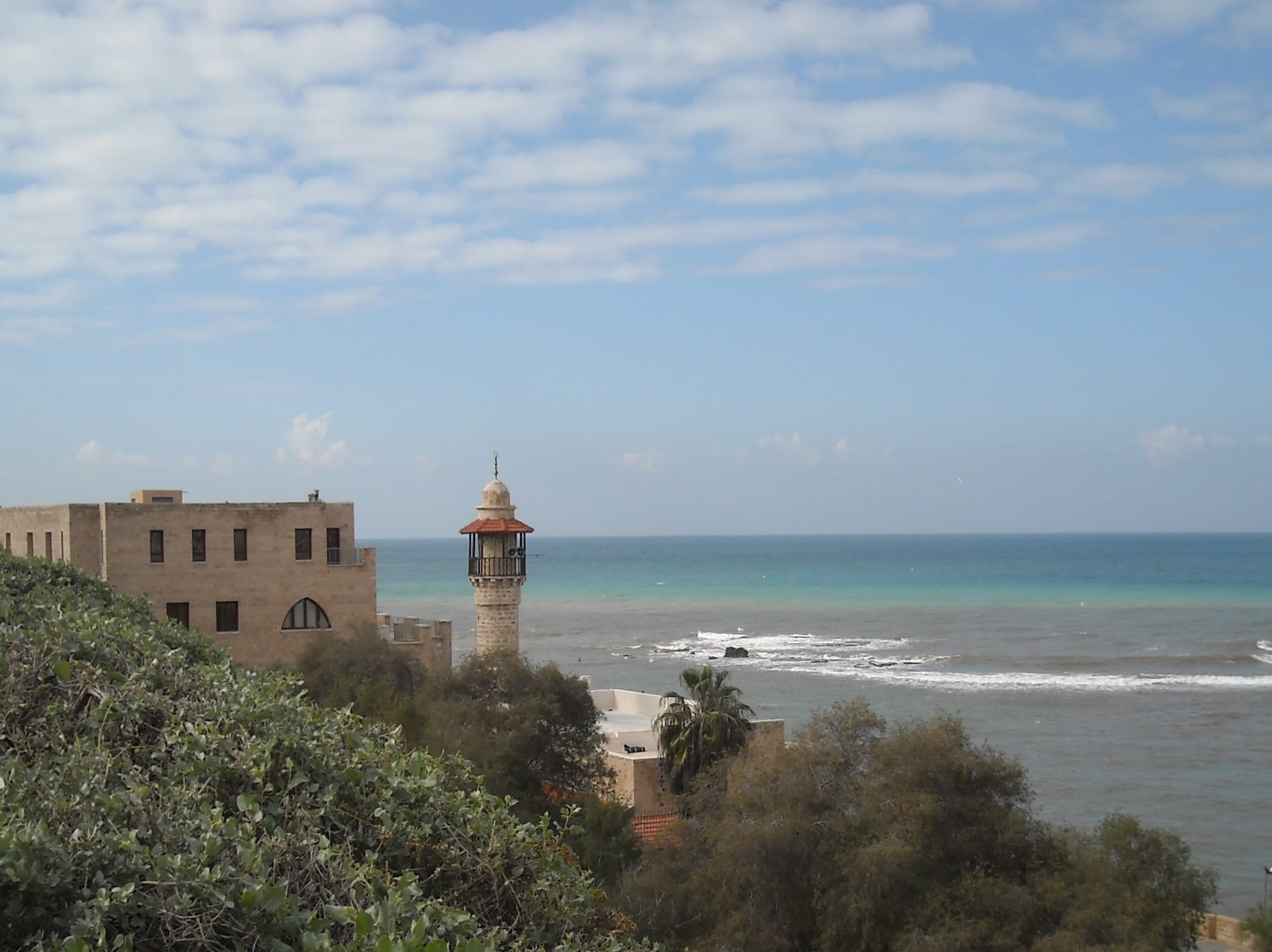
For the past two days, I’ve taken the train from Rehovot into Tel Aviv to explore a bit on my own. I especially liked Jaffa, with its views of the Mediterranean Sea, its ancient port, and its hilltop garden. I arrived as the adhan was called from the minaret tower around noon, and sat by the clock tower eating a pear pastry. Unhindered by an official guide or an abundance of facts, I let myself cross to another time around every corner. It’s an odd feeling. You know, rationally, that you’re just a dopey tourist who doesn’t speak the language, but you also have this light-hearted, wistful empathy with the ghosts who still wander the narrow, steep streets.
Later I wandered into the flea market, where men hunched on stools and threw rapid games of backgammon. No object was too mundane or useless to be up for sale: old cell phones, TV remotes, battered pots, used shoes, vinyl records, and metal keys. A warren of market streets and alleys offered art, furniture, menorahs, dishes, locket watches, and jangly hip sashes for belly dancing. Since bargaining is the custom, no prices were marked, so I had no idea what anything was worth, not even in shekels.

I could identify with this sculpture at the Tel Aviv Museum of Art.
My favorite interaction involved a taxi driver. After my time in Jaffa, I walked up the seaside boulevard to downtown Tel Aviv, and when my feet gave out, I asked a cabbie for a ride to the Ha Hagana train station. He informed me he only traveled north, so that station was outside his range, but he urged me to be certain that no other driver charge me more than 30 shekels. He said that since I wasn’t from around here, another driver might take advantage. I thanked him and began walking away, and then turned back. “Could you take me to a train station that’s within your range?” I asked, since any station on the line would suffice. He agreed. When I climbed in, he said “I’m playing this for you,” and popped on Adele’s “Someone Like You.” Imagine rollicking through Tel Aviv in the back of a cab, listening to Adele with a cabbie who sings along.
Much of my time here has underscored how difficult it is to navigate an unfamiliar place without knowing the language or customs. I expected to find English because it’s one of the official languages of Israel, but it’s more of an afterthought to the Hebrew and Arabic, occasionally making an appearance on street signs and tourist shops. For instance, I would have welcomed English announcements of stops on the trains when I couldn’t read the Hebrew. I’m not used to having my purse searched as it was four times today, or seeing college-aged women and men in uniform everywhere. When strangers spontaneously spoke to me, I had to smile and apologize because I didn’t understand them.
But it all worked out. True, I have only a superficial acquaintance with Jaffa and Tel Aviv, but I have a better understanding of myself in a strange place. I’m not afraid. I’m independent. I can learn. I will be kinder to aliens when they show up in my hometown.
Imaginary Friends
You know the way your dead grandmother can pop up in the car with you? You know just what she’ll say about slowing for the stop sign, and how she’ll cross herself when you pass St. Luke’s. Her chortly, spontaneous laughter will float right through you. It’s memory, but it’s also alive, fluid. It’s strong because it’s yours alone, in your own mind, especially if you practice bringing your grandmother forward.
If you’re not a writer but you know remembered real people, that’s what characters feel like. My characters feel convincingly full and true to me. They’re not only on the page when I’m copying down the gestures I see or the voices in my ears. My characters sometimes join me when I’m doing dishes or taking a walk. I’ve never seen Gaia’s or Leon’s face distinctly, but I know what her scar feels like on my cheek and I’ve glimpsed the back of his neck on other teen boys. I would know them if I saw them, like you’d recognize your grandmother if she knocked on your door.
Furthermore, I know my characters inside. I know their memories of when they were kids (picking blueberries), and what they’re like when they’re sick, hurt, or grieving (Q cell). I know how they feel about the mistakes they’ve made and how they’re worried they might do worse. I know their emotions when they’re so angry they can’t give me any dialogue or explain themselves. (That would be Leon on the porch of the winner’s cabin.) Their wondering happiness in an embrace is mine, and so are their discoveries and curiosity.
They’re my imaginary friends.
We tend to associate hearing voices with insanity. A psychologist friend recently said to me that creative, artistic types are more likely than the general population to be on the functional end of the manic-depressive spectrum. Frankly, I find the generalization dangerous, as it implies that artists, especially those with mental illness, succeed only because they have a crazy gift of creativity rather than because they work their butts off.
Recall that writers practice creativity 8-12 hours a day, daily, the way doctors, teachers, athletes, and plumbers practice their craft. You get good at what you do.
I know my peeps.
Priorities and Resolutions
Priorities
1. Family
2. Writing
3. Friendships
4. Healthy Body
5. Singing
6. Fun
7. Community
8. World
9. Church
10. Home Upkeep
Resolutions
A. Be a better friend
B. Eat healthily
C. Find meaningful ways to contribute in my community
D. Streamline home upkeep