Archive for May 2011
From the Hammock
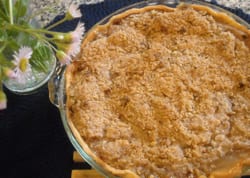
Arguably, the most productive thing I’ve done this weekend is mow the grass. Not that anyone’s arguing. I also spent an entire day in the hammock reading, mixed up an icy pitcher of home-made lemonade, and watched my daughter make a pear and peach pie from scratch. Then I ate a wedge or two.
We know how to slow down, here in Connecticut, come Memorial Day weekend. A neighbor stopped by with her dog to bring me a flyer about a potluck and sat in a lawn chair to catch up for a bit. My son had four guys sleep over in the boy cave, playing League of Legends until the middle of the night. I opened all the windows in the church when I arrived early yesterday morning, hoping to cool it down a little before the service, and one of the elderly parishioners joked that the circulation should be tolerable as long as we didn’t get an arctic blast.
We’re having a stretch of days so green and lush that every leaf and blade of grass is the same ripe, primal color, and I don’t need a prophecy of doom to remind me we are now living in The Garden. This is innocence, untroubled paradise, a moment to store up while elsewhere the world contends with tornados and war. We’ll get our share of loss again, like we have had in the past. We’ll pay for our wisdom. We’ll mourn. It is Memorial Day, after all, and far away in another state, my father’s grave has yet to see its stone marker, but today I’ll honor the once-alive by living myself, and relish from my hammock the fecund beauty of May.
Q. Do You Think Social Media Matters to Writers?
A. I did not, initially, find the prospect of joining social media innately appealing. Do not mistake me for shy or insecure because I’m not, but I am rather private and low-key. I’m the sort of girl who’d rather hang out with a friend on the couch than dress up and go to a party, and social media looked like a party of strangers. Besides, I was busy writing, and I hadn’t considered that interacting socially with new people online might be worthwhile.
It turns out it is worthwhile, even delightful, especially when you find ways to interact that suit you. Personality matters when a writer considers what to do with social media because you can stretch yourself, or burn out, or invent a natural fit. In each case, you start as a non-entity and then convey some of your real personality through a series of interactions over time. A careful, thoughtful person is not going to blossom into a wit of extemporaneous charm, even if she wants to, but that’s fine. We’re drawn to unique voices.
It’s sort of funny to be writing this because I’m hardly a big online presence, but still, I do have a few ideas I can pass along to others considering starting up, ideas that would have been reassuring to me to know when I did. I think there’s a misconception among new writers that you need to jump in fast, hard, and early, or you’ll be doomed to oblivion and your book will have dismal sales. I think what matters is the quality of your book, and social media should never come before that. It helps to be realistic about how much you want to do and what you have to contribute. As in everything else, it helps to be real.
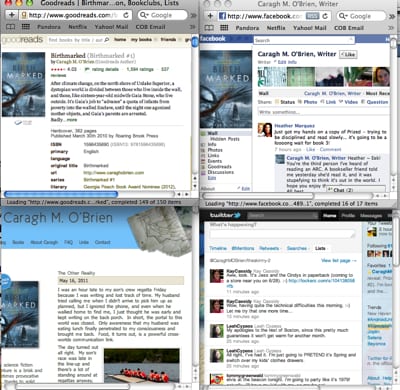
For my purposes, I consider social media to be any place where a writer can interact publicly with others online. For me, that means Goodreads, Facebook, my blog, and Twitter. Other venues certainly exist, too, but that’s all I can keep track of. A little of it I started before Birthmarked was released, but most of it kicked in well after.
I joined Goodreads ages ago as a reader with a private page listing my collection of favorite books, so it was fairly easy to convert my page there into a public one as an author after I sold Birthmarked. Goodreads makes it easy to find fellow like-minded readers, run giveaways, arrange an author chat, and cross-post my blog. It also gives readers an easy way to post reviews and ratings, and to send me a line. It’s a no-pressure community of readers I can drop into casually and effortlessly.
Facebook was a little trickier for me because the whole accepting-friends business just felt weird to me. Still does, frankly. My daughter set me up with a page as a writer (as opposed to a profile as a private person) where people could “like” me, and it was a relief because a line was clearly drawn. My sister had been bugging me to talk more about my writing stuff but I’d been reluctant to bore my friends and family with details. Now, with a writer page, I had a place to do that and people could tune in or not as they chose. It also gave me a place where I could interact with former students, which I’d been unwilling to do on my private Facebook profile, so the writer page connected me both to kind readers I’d never met and people I already cared for. Like Goodreads, it’s easy and fans seem to feel comfortable popping in when they want to talk. This morning, someone posted that she has Prized and I squealed.
My blog came next. Last summer, several months after the release of my book, my persuasive agent convinced me to start blogging to provide a bridge between Birthmarked and the sequel. He pointed out that readers, especially YA readers, would look online for more about me and Birthmarked, and fresh information would feed their interest. When I argued that nobody cared about what was cooking on the back of my stove, he said I could write tie-in stories and bits about the world of Birthmarked. That interested me. I agreed to experiment with two posts a week for two months. By the end, I found I liked thinking about characters at different ages. For posts about writing, I liked stepping back from what I do to think about the process. Even the challenge of adding images appealed to me and influenced how I thought as I wrote. In short, I gained personally from blogging, and it turned out my agent was right because visitors do drop by. When they email me, I get a sense that they’ve connected with me because of what I’ve written.
My most recent venture has been into Twitter, which I find pretty goofy. Besides getting NPR headlines there, I’ve lurked at a couple #yalitchats, impressed by how generous that free-flowing community of writers is. I’ve found my fellow writer friends on Twitter and laugh at their posts. When my editor Nancy Mercado posts a link, it’s often worth the side trip (Twitter tips), and through Twitter, I’ve connected with two other writers who also work with Nan. They’re like my cool half-cousins. Regardless if it’s Goodreads, Twitter or whatever, the vehicle doesn’t really matter because it ends up being about the people.
Does any of it make any difference? Of course it does. I may write my books in isolation, but I am part of a far-flung community and I have much to learn. Being connected increases my serendipitous chances of discovering lovely or disturbing new things. Best of all, I realize I’ve gradually been building friendships with people who matter to me, and that’s making me a better friend and a better writer.
The Other Reality
I was an hour late to my son’s crew regatta Friday because I was writing and lost track of time. My husband tried calling me when I didn’t arrive to pick him up as planned, but I ignored the phone, and even when he walked home to find me, I just thought he was early and kept writing on the back porch. In short, the portal to this world was closed. Only awareness that my husband was eating lunch finally penetrated to my consciousness and brought me back. Food, it turns out, is a powerful cross-worlds communication link.

Quonnipaug Lake, Connecticut, May 2011
The day turned out all right. My son’s race was late in the line-up and there’s a lot of standing around at regattas anyway, so we didn’t miss anything. Even so, I was embarrassed with myself, which is a strange type of embarrassment. I don’t want to be that spacey a person. It feels irresponsible and selfish to check out of reality so completely.
In a contradictory direction, I sometimes feel guilty that my job is this self-indulgent escape from reality while plenty of other people living on our planet have no escape from their hunger and war and homelessness. I feel like I ought to be working harder to deserve the happy time in my head. I feel like I need to earn it when other people, like other versions of me at other times, are enduring crappy jobs when they’d rather be artists. If I have an unproductive day, I’m wasting much more than just those hours. I’m wasting a cushy gift of opportunity.
I think about what I would have given, back when I was a stay-at-home parent with two little offspring, for a day of nothing to do but write. It was impossible to arrange. For the sake of that starved, mind-benumbed version of me, I feel like I can’t afford to waste a single writing minute. I can’t forget how terrible it was then, writing deep into the night when my family was asleep, knowing the longer I wrote, the more exhausted I’d be the next day, and how much worse reality would be because of it. The escape time poisoned the real time, but like an addict, I had to have it.
Now, somewhere between these two extremes—writing myself out of reality and chastising myself for not writing enough—there is probably a place where I’m doing enough writing and also clued in enough to my family and my real world. How to find that place is the question. I’m open to suggestions.
Book People
Last week, Billie Levy and I figured out how to use the camera feature on her cell phone so we could ask our waitress at Rizzuto’s to take a photo of our happy lunch with Karen Romano Young and Kat Lyons. Billie and I huddled together, pressing buttons and switching through the menu layers in an ever deeper maze of tiny icons, and I must say, it was a kick when we hit the first instant the screen was clearly seeing through a lens.

Billie Levy, Caragh O'Brien, Karen Romano Young and Kat Lyons all post-dessert.
You can see the victory in our faces here, with Billie still holding her phone.
(Yes, it’s a small thing, mastering a cell phone camera, but hey. Remember how sci-fi and magical it was when Captain Kirk and company had communicators? Now I have one! And it takes photos! My family gave me a new cell phone for Mother’s Day because A) they love me and B) my old one only worked with the speaker phone feature on. In effect, I could only have very loud, unprivate conversations. I have yet to figure out how to transfer the photos from my old phone to my new phone, so I feel a bit bereft and confused with a generic boat scene where my kids used to be for wall-paper, but hey again. I will figure it out. I will master my own cell phone.)
But back to last week. Billie Levy hosts Children’s Books: Their Creators and Collectors for the local WHC-TV station in West Hartford, and she very kindly invited Kat, Karen and me by to tape a segment in anticipation of the Connecticut Book Festival. Kat Lyons, co-chair of the festival, has worked for over two years with partnership colleagues throughout the state to organize the free event, which promises to bring thousands of book lovers to the UConn Greater Hartford campus May 21st and 22nd. Karen and I are among over three dozen writers who will be presenting at the festival, some of us individually and others on panels. It should, I think, be very fun.
What’s nice for me is that the festival has already brought me together with Billie, Karen, and Kat. After the taping, we scooted through the rain to the nearby Rizzuto’s, where we talked of Osama Bin Ladin’s death, finishing school in Puerto Rico, Maurice Sendak, public education, and the girls-only book club GRLS. We talked of the Northeast Children’s Literature Collection, walled medieval cities in Tuscany, book collectors, and desserts. Then we ordered two to share: the fluffy white cake with peaches and the twelve-layer chocolate cake.
You know what? Book people are nice. They don’t come any more generous and genuine than Billie Levy. Being with her, Kat, and Karen for a day made me want to find ways to be more giving myself. I hope you know people like that, too.
Raising the Stakes
Suppose your character is running late. If she’s late to class, or late to her sister’s wedding, or late to see her mother on her deathbed, the stakes are different. Suppose she needs to exit a room. It makes a difference if she can simply walk out, or the door is locked, or the room is on fire. Next suppose she needs to get out of a burning, locked room in time to save her mother from dying. We’ve just raised the stakes.
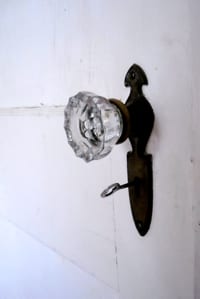
Locked in.
In the poker analogy, there’s more money in the bet, more at risk, more to lose when a player raises the stakes. The game matters more, so the gambler or the reader cares more, too. In the best stories, we’re playing for keeps.
Of course, we can’t have houses on fire all the way through our novels, and too many fires or chase scenes can make a book feel contrived. The escalation of trouble needs to be grounded in reality, but inevitable, like the on-going train wreck in Of Mice and Men, which seems like a simple story about friends while underneath (spoilers ahead) the violence keeps building: dead mouse, euthanized pet dog, mutilated hand, murdered puppy, murdered woman, murdered friend.
It’s easy to see it in retrospect, as a reader, but how do you raise the stakes as a writer?
It’s not a simple matter, even when we already grasp that conflict is the key. A mistake that’s easy to make is creating characters who get very worked up over something small, a thing with no other emotional weight around it. A man and a woman arguing about tearing down or preserving an old windmill, for instance, might seem promising because of the culture and history involved, but already I’m thinking, who cares? I’m already expecting the characters will seem sort of silly or quaint or unreasonably stubborn when they get all worked up (which, incidentally, can work quite well in comedy). If a writer is told at this point, “raise the stakes,” someone can bring in a bulldozer, but it still won’t have much power to engage me.
On the other hand, if a man and a woman are arguing instead about the custody of their son, I’m already anxious. It matters. If the father agrees to pierce his son’s ear when the mother has told the boy no piercings are allowed, that’s a conflict with emotional promise. The thing—the ear lobe—is small, but the relationships around it are deep. If now it turns out the old windmill is the home of the boy’s mother, who is a deaf artist and makes her living selling her paintings there, now I care about the windmill, too. Try a bulldozer now, on top of the pierced ear, and the stakes—the risk for loss and vindictive pain—are much higher.
If we start with a conflict that has sincere emotional consequences and turn the characters loose, it’s likely the stakes will rise automatically and naturally. You can think about it in simple terms of escalation, (Who has eaten my porridge? Who has broken my chair? Who is sleeping in my bed!) but it’s the betrayal or loss or outrage that will give the story resonance. For that, someone has to be at risk, in different emotional ways, in scene after scene. The potential for hurt can be subtle, as when a character is misunderstood or isolated, but it needs to be there.
If you’re a seat-of-the-pantser like I am, and you aren’t working with an outline of the story arc all planned, it helps to feel in each scene, while writing it, that things are purely getting worse. Surprise: the patient father gets violent when his authority is thwarted. Surprise: the boy who seems ready to skip school won’t go with his friend. Raising the stakes is not just a plot device; it allows the characters to become more complex and interesting. We see what they’re like under pressure, and we learn even more when we make our characters exert pressure on each other.
If you’re trouble-shooting a scene and you think you need to raise the stakes, make sure first that your characters are in a problem that really matters. Delete any paragraph that’s just sitting there not advancing the action. Make a character do and say things that will make the situation worse, especially if she means well. Lock the door so she has to sneak out a window. Add rain so she’s miserably wet and cold. When she thinks she can’t be a midwife anymore, confront her with a woman in labor. Give her scars that matter.