Archive for March 2011
The Rowdy Book Groups
Over the past year since Birthmarked came out, I’ve talked to twelve book groups (two via Skype) about the novel, and I’m meeting a week from today with another book group, a group of teens, at my old high school in St. Paul, Minnesota. That should be cool.
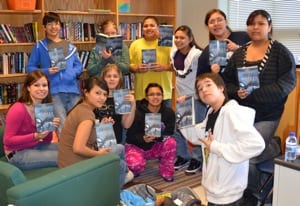
I'll be Skyping with the Fond du Lac Ojibwe School Book Club in Duluth, MN soon.
Talking to a book group is a curious experience for me, especially when the people are all friends already. Some of the groups have shared history that goes back years. One group formed when swimmer parents, who had spent hours poolside cheering on each other’s kids, no longer had swim meets to go to and decided to keep their friendships going around books. Other groups have formed around moms whose toddlers play together, or after school with a teacher or librarian, or through a library. One was composed of mother-daughter teams. The teen groups have had boys and girls, while in the adult groups I’ve visited, men are rare but they sure speak up.
After welcoming hellos, some visiting, and often some refreshments, there invariable comes a moment when we all sit down to discuss Gaia’s story, and that’s when I never know what’s going to happen. Sometimes no one has any questions, so I launch into stories about how I came up with the first idea for the story, how I found a publisher, and how the story originally had a different ending. Other times the hostess has a whole list of really thoughtful questions or someone moans about Leon and we jump right into pondering the story. Some groups get sort of rowdy, with bursts of conversations taking off between people all at the same time so we have to call order and take turns. Actually, come to think of it, even the most polite groups have had a rowdy element. Fortunately.
We head off on tangents about the medical system in our country, or poverty, or absent parents, or whether school sets you free or imprisons you, or whether you’d rather risk having to give up your kids for adoption or risk being infertile. We talk about people with hemophilia, and kids with special needs, and whether Gaia is too sensitive about her scar. We talk about beauty, and why girls today are still judged for their appearance. We talk about violence in young adult books, and if that’s okay. (It is.)
Eventually, people want to know about the sequel, and then, even though of course I know they haven’t read the second book, it’s still odd to me that they don’t know what happens. To me, there’s no longer a clear line between Book 1 and Book 2—they’re a continuation of the same project. What comes next just seems logical to me, though I can’t outline that here without the risk of spoiling the end of Birthmarked for people who haven’t read it yet. I listen to people’s predictions, and I think, Yes, that’s good. They’ll like what I do with that. Or Woops, they’re not going to like how that turns out. Or Wow, they’re going to be surprised.
I end up wanting to jump forward a year to have another conversation with the same people. Most of all, I feel thankful that my story has found its way into the right hands. Long live the book group.
The Paris Book Fair: Quite Fun

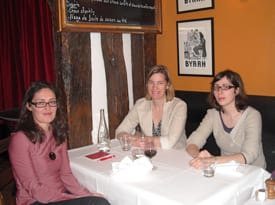
Audrey Petit, Caragh O'Brien, and Sarah Millet in Paris, 2011
My French editor at Mango, Sarah Millet, kindly fetched me from the airport in Paris a couple Fridays ago, and we were joined by Audrey Petit, the sci-fi series editor of Mondes imaginares, for lunch at La Marlotte, a quaint restaurant in the 6th arrondissement. Sarah was friendly and engaging from the first hello. She spoke of how she came to Paris to study, stayed on to work in publishing, and has grown to enjoy the busy city as her friendships there deepen. Audrey welcomed me warmly, too, and when I asked her how she entered publishing, she explained that she originally studied philosophy, then started editing in sci-fi and fantasy. Eventually, she advanced to directrice de collection, and as such, she edits collections like the one I’m in at Mango and another at Orbit. We spoke of the shortage of childcare, the beleaguered educational system, our concerns for devastated Japan, Colin Firth movies, and President Nicholas Sarkozy’s low popularity, but most of all, we talked of books. It was fascinating, and so, so fun.
In case anybody cares about such things as food, I can report that I enjoyed a creamy vichyssoise with asparagus, then salmon over a bed of creamed leaks, and then chocolate liégeoise, which is extremely rich chocolate ice cream with mountains of frothy whipped cream in a tall glass. Note the cream theme. Hard to go wrong there. Thanks again, Sarah and Audrey!
Afterward, we went to the Salon du Livre/Paris Book Fair, where thousands of books and booklovers filled a room so vast I couldn’t see from one end to the other. The air hummed with French voices. Colorful book posters hung overhead, and a stage was busy with a panel presentation. At the grid location E44, Fleurus Editions was set up with brightly lit bookshelves and tables, like a mini bookstore.

My daughter and I, Salon du Livre 2011
I met some of the people on the team who decided to wrap my book in a ribbon—that red band of the title is actually printed on fabric—and they also showed me the website where people can take a personality quiz related to characters in the book. How cool is that? Two other writers for Fleurus were there, too, and I had a chance to talk with them a bit about next projects and balancing writing with life. We’re all doing versions of the same thing, it seems. As I sat at a table close to the aisle, with a poster of the cover of my book behind me, people stopped by to chat and ask me to sign my book. A few even asked for photos, which I found amusing.
The happiest moment was when I glanced past my next group and saw my daughter standing there. She’d come from Rennes, where she’s a student, to meet me, and I was so happy to see her. Books are about bringing people together, you know? Sometimes they bring people together in unusual places, like Paris. I’m so grateful Sarah invited me to sign at the Salon du Livre. For me, the entire day was unforgettable.
Behind the Scenes: A Note on the French Translation
My daughter and I met Hélène Bury, the French translator of Birthmarked, in front of the Hôtel de Ville in Rennes at 10:00 Saturday morning and instantly bonded. Hélène is funny, smiley, and genuinely nice, and what’s more, she and I have certain things in common that sealed our friendship: we both prefer hot chocolate to coffee and adore Colin Firth.
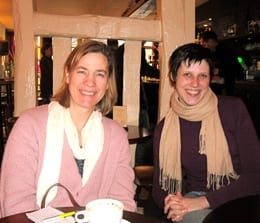
C. O'Brien and H. Bury, in Rennes
I’m particularly grateful that Hélène was chosen to translate my novel. In the first place, she has lived in Texas, so her command of American English allows her to grasp the subtleties of connotations in the original text. Consider, for instance, how “slender,” “thin” and “skinny” are all versions of the same concept but convey very different meanings. “Finish” and “terminate,” are literally close, but one seems far more violent. In a similar vein, when I have characters say something sarcastic, I choose words that will make that clear to an American reader without having to add a clumsy “he said sarcastically” in the tag. I also pick certain words because of how they convey a character’s education or attitude, so the language in dialogue is especially important to me. There are layers, too. If Leon is described as “dreamy,” the word sounds sort of cute and dated, yet when a teen says it in a teasing way, it adds a quick sting of humor.
Hélène made thousands of word choices to accurately translate Gaia’s story into French, but there’s another factor I hadn’t considered. She explained that sometimes one word in English would need three words in French to translate accurately, and it simply couldn’t be done with any artfulness, so something got lost. Conversely, there were other places where a literal translation was possible, but there was a more graceful way to say the same thing in French. In those cases, because she’d had to drop out a certain element in one place, she tried to add it back in where she could. She knew what would sound smooth and polished in French, knowing that was what I valued in my English.
It’s very clear to me that my book was entirely in Hélène’s hands, and that translation is another form of writing, really–an art in itself. In her effort to do the best job she could, Hélène asked her parents to read her translation to check for clarity or confusion, which is exactly the sort of thing I would do (Merci à vous, les parents!). To my delight, she and her parents invented a verb “Gaïater” that means “to work on the translation of Gaia’s story” because that’s what Hélène was doing so intensely for so long. (Bonjour, Hélène. Qu’est-ce que tu fais ce soir? Je Gaïate.)
Finally, there’s another reason why I’m glad Hélène was the one who translated Gaia’s story. She gets Gaia. For me to sense a kindred spirit in Hélène so quickly, I believe we share some of the same sort of vulnerability and strength, the outsider-ness and longing that underscore Gaia’s own character. This translation wasn’t only an intellectual exercise, but a work from the heart, too, and that pleases me enormously.
I’d like to add that of course the translation also depended upon my wonderful French editor Sarah Millet for even more fine-tuning, just as it went through many versions of editing in the original American English. Birth Marked Rebelle is really a book in its own right, another team effort. I’ve been reading it while I’m here in France, skipping ahead to my favorite sections, and je dois dire, it makes me très heureuse.
Coincidences
Coincidences tend to be unbelievable in fiction, but I’m living with a couple of curious ones now in my real life. A year ago, when my daughter told me she wanted to study in France, she applied to a program at the University of Rennes, and Rennes just happens to be the city where Hélène Bury, the French translator for Birthmarked, resides. What are the chances that my daughter and my translator would end up in the same city, giving me ample excuse to visit?
Off to France
Hélène and I have become friends via email over the past year, discussing things like how to translate “Masister,” and how much she loves West Coast Swing dancing, so I’ve been looking forward to meeting her. When I told her I was coming to Rennes this March, she kindly offered to help line up a book signing in the city. We’ll be at Virgin from 15:00-16:00 this Saturday. I’m not sure how common it is for writers and their translators to have a chance to meet, let alone do joint book signings, but I’m guessing it’s rare, and I’m pretty happy about it.
I’m having a coincidence of timing, as well. The reason I’ll be in France this weekend rather than another is because my husband is speaking at a conference in Germany, and we wanted to fly over together to combine a visit to our daughter with his work. When I mentioned to my French editor, Sarah Millet, that Hélène and I were doing the Rennes signing, she asked if I could do one in Paris, as well. The one date I happen to be in the city, tomorrow, is the first day of the Paris Book Fair, and Sarah invited me to sign there, so I will. Again, what are the chances such timing would work?
Stars sometimes do align. It almost makes me think a coincidence or two could work in fiction.
Q. How Much Do You Write Every Day?
Q. How much do you write every day? Do you have set hours to keep yourself disciplined?
A. I always secretly cringe at these questions because I suspect my answer makes me sound sort of pathetic or crazy, but here goes:
Normally, I write all day. I wake up, take a shower, and start writing. I stop for breakfast when I’m hungry, and then I write. I stop for lunch, then write. I stop for a walk, then write. My family comes home and we eat dinner, and then I write until I have to go to bed. I try to stop by nine or ten, but often don’t succeed. I try to write less on weekends, but often don’t succeed there, either.
I take breaks for email, answering interview questions, and writing blog posts, unless you count that as writing, too.
There are some exceptions. Most of my writing is revising, which I love, so I can do it endlessly, but when I’m working on first drafts, which are hard for me, I set myself a five-page daily minimum. If I can finish my five pages by 3:00 in the afternoon, I’ll knock off then, but if it takes me until 10:00 p.m., I write until then. Months of that are not as fun for me, but I usually do my reading then, too, to lighten things up.
Of course, I also put writing on hold for normal things, like seeing movies and singing in a chorus and going to my son’s school events. But I suppose, if I had to count it up, I probably normally write 10+ hours a day. So, no, I don’t have set hours, since I write whenever I can. I’m not a particularly fast or prolific writer, and that’s what works for me.
I should add that, apart from spending time with my family, writing gives me more intense mental satisfaction than anything else I know. It’s the puzzle I both solve and invent, every time I enter into it. I want to be writing all the time, and I feel lucky that I get to do so. Tennessee Williams is the one who said that the ticking of the clock is “loss, loss, loss” for the artist who isn’t at his craft. I feel like he was speaking to me, because for me, each minute writing is one fully lived.
Becca the Highland Cow

Becca the Highland Cow (c) Becca Hart 2011
And now for an inspiring photo by my talented niece, Becca Hart. Thanks for the laugh, darlin’.
Behind the Scenes: From Copyedits to First Pass Pages
After I finished going through the copyedits of Prized, I emailed the manuscript back to my editor Nancy Mercado at Roaring Brook in mid-December. The next step was a series of emails we had in early January, when Nan checked back with me about a few of my changes and other things she’d noticed, like whether a character would be called by his first or last name in a particular line of dialogue. Here’s another example, with my reply in italics:
Pg 153 “She might be too polite to say anything, but she was far from blind.” This isn’t part of Dinah’s dialogue, is it? Just checking. You just mean add this to the line, yes? Yes. It is NOT dialogue, but just a comment on her thinking, and it goes on the same line as Gaia’s “indeed” line because it’s Gaia’s reaction.
All writing, revising, editing, and copyediting were finished, and at that point, Nan told me the book was heading off to layout—a significant milestone. That was when the manuscript would be transformed from a Word document to pages that actually looked like a book.
Most of the design work didn’t involve me, understandably. However, anytime I included an image, like hand-writing or a freckle pattern or a map, it was a design issue where my input was considered. Like Birthmarked, Prized also has a code in it (why not, right?) and for the original manuscript, I drew the code, took photos of it, and dropped the photos in the document where I needed them. They were basically place-holder images, but once designer April Ward was considering the look of the page, I rewrote the code again, took more photos, sent them in, and conferred with Nan about which images we actually needed. By early February, Nan forwarded a file to me of how the thirteen pages with specific design issues would look. They seemed gorgeous to me, frankly. By the time April finished refining, even a certain shadow was perfectly aligned. It’s the sort of thing that delights me, and I am deeply grateful for April’s beautiful work.

First Pass Pages for Prized
This week, Nan sent me the first pass pages for Prized, with each page laid out exactly as it will be printed in the final book. Now is my chance to read through it one last time for any changes I can’t live without. It’s like the dress rehearsal. I have several weeks until the deadline, and I’ll need the time to read as carefully as I intend to, hopefully twice.
Though I’ve reread parts of Prized while I’ve been working on Book 3, sometimes to check a detail and sometimes because I just like being with friends in favorite scenes there, I haven’t read through the entire story since December, so I should have fresh eyes for the job. I’ve never read the story on paper at all, and that makes it new for me, too.
And so you find me today at the dining room table, armed with a new pen, and I’ve started going through my first pass pages of Prized. The first chapter looks clean to me, and I’ve made only a few tiny changes, so I’m optimistic this part of the process will go smoothly, especially since I’m eager to get back to revising Book 3. Nan and a proofreader are going through these pages, too, and between the three of us, here’s hoping we catch anything monstrous.


A figure sat cross-legged on the floor of the porch, huddled over a jumbled handful of small gears. The slant of the late sunlight had shifted the line of shade into a sharp diagonal, and when he glanced up, he had to squint in their direction. Bonnie realized he wasn’t a child with toys, but a young man only slightly older than she was.