Archive for February 2011
Note to Self: Keep Going
The Uninspiring View
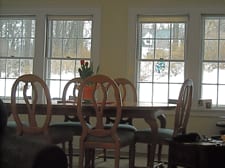
The view from my couch is not inspiring. It’s raining on top of several feet of old snow out there. I dropped off the car for new tires before Rini’s garage opened and walked home in the rain, over ice, falling once. So far today, I’ve revised one page of Book 3, and I can already tell: it’s going to be work this morning. Looking at glamour photos from the Oscars last night is not going to help, nor will going to dig up my stealth supply of chocolate chip oatmeal cookies from the apron drawer. I’m still going to have to work.
In some ways, I was more desperate to write when I could do it only one-handed while breastfeeding, or when I was writing in 25-minute lunch time chunks between classes. Now I have enough time to write. Now writing is all I do, frankly. Normally, I have a sense of gratitude and I grasp clearly that what I do today is part of completing a year-long project, which is further connected to my ability to sell other projects and earn my life writing on the couch. Normally, I love writing, and often it is a total, fascinating joy.
But some days, it’s not. The people in this scene make me tense and fearful, and I don’t want to be with them. I’ll probably make more cuts than additions in the next few hours, and words will come in chunky bits, like they have for this sentence. None of it will be fun or easy. Nevertheless, I’m going to do my revising, all day long. It’s not that I have any special gift for self-discipline. I have a job, and it’s time to get to work.
To Love, Cherish, and Critique?
I asked my published writer friends if they show their writing to their spouses or loved ones, and out of twelve writers, five of us only rarely, if ever, show our work to our spouses, and seven of us regularly do. A few of us show our spouses our writing every day and depend upon their feedback as an integral part of the writing process.
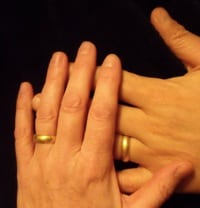
Showing your writing to anybody always involves trust, and when you show it to someone you respect and love enough to be your life partner, the stakes can be high. So can the rewards.
My writer friends who show work to their spouses count on their readers to be respectful and honest. Gentleness counts, too, and being clear about what is really wanted from the reader. Stephanie Burgis, who is married to another writer, Patrick Samphire, swaps her writing with him every day, and she says they are careful to be only positive about first drafts. “Then the draft gets finished…and the rules change,” Stephanie says. “At that point, we become each other’s toughest critics, because we care so much about each other’s work, and we want it to be the best that it can be. Every critique starts and ends with something positive and true, but in the middle we are ruthless.”
Some of us writers who don’t confer so closely with our spouses still depend upon them for help with brainstorming, whether with plot sequences or details in our spouses’ areas of expertise. My husband is a professor of physiology and neurobiology, so when I have questions about suppressor genes, he’s the one I consult. I’ve shown him specific passages for reassurance I haven’t bungled anything, and I find such input invaluable.
Beyond that, however, I don’t ask him to read my work, and I’m not alone on that. Some of my writer friends have spouses who genuinely have no interest in the types of books we write. Some of us are so sensitive that we take even the mildest suggestion as a harrowing criticism, and don’t want that stress to trickle over into our marriages. Some of us enjoy keeping our jobs separate from our private lives, especially if we tend to get lost in our heads and depend on our spouses to keep us grounded in the non-writing world. Without exception, even those of us who never seek out our spouses’ input on the nitty-gritty feel their devoted support.
Support is the key, no matter what kind it is that we need. Each writer has to discover what works best for him or her in terms of seeking spousal feedback. I’m going to throw out a radical idea here: I think we’re married first and writers second. You know, like those people with other jobs.
Facebook, Amigas, and a Foreign Rights Deal
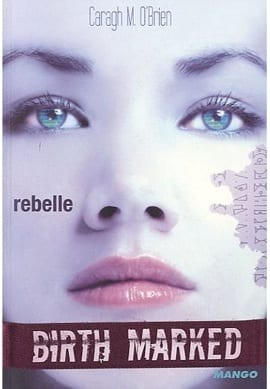
Thanks to the Internet, I’ve become friends with Eva Rubio, a university student in Salamanca, Spain, who blogged enthusiastically about Birthmarked last summer. Eva was determined for Birthmarked to be translated into Spanish, so she and her friend Rocío Muñoz started a Facebook page aptly named Queremos que Birthmarked de Caragh M. O’Brien sea publicado en España and started collecting followers. I thought they were unbelievably nice, but I didn’t hold out much hope.
When my family made plans to visit Salamanca last summer, Eva and I realized we could meet in person. I was beyond excited. Not even my lack of Spanish could deter me. Curiously, Eva’s grasp of written English was so good that she could read my entire novel effortlessly, but she couldn’t understand spoken English or speak it any better than I could understand or speak Spanish, so she brought along a couple friends, Cris and Leticia, and Leticia interpreted for us. I brought along my college-aged daughter, and the five of us strolled around the midieval quarter and Calle del Toro, visiting boutique bookstores and window shopping. We laughed a lot. We bonded. We were friends.
In our last moments together, we shot a tiny movie of Eva and me together in the incredibly beautiful, lively Plaza Mayor. The whole thing was sweet and goofy beyond belief.
Within a few weeks of its initiation, the Spanish Facebook page had more members than my American Facebook page had gained in months, and when I spoke to my agent shortly after my trip to Spain, four Spanish publishers had contacted him about foreign rights. That was June. A month later, my agent told me we had an offer from Grupo Everest. I could hardly believe it.
Along the way, the original Spanish Facebook page lost its administrators, but Eva and Rocío started a second one. They were unstoppable. One of their friends created a Spanish book trailer, and others found photos of actors (one quite caliente, I must admit) who resembled the characters. They linked to other reviews, signings, a giveaway, music, and basically lived it up about Gaia’s story. I could hardly make sense of the Spanish, but it was definitely silly and fun.
When I heard the news that the deal with Everest was final, I asked Eva to be the one to announce it, which she did on her website and on Facebook last week. Now it’s for real: Birthmarked will be published in Spain this fall.
It’s all thanks to Eva and Rocío, and the sweeping reach of Facebook. Gracias, mis amigas! Gaia sends her love.
O, Singing Pioneer.
My mother’s friend once invited me to lead a sing-along for the Pioneer Homestead Society at the Minnesota State Fair. “She’s looking for someone young,” my mom said, which should have been a tip-off right there that the event was doomed. Did you ever notice how you can say no to your mother, but you can’t say no to your mother’s friend? I imagined this musty room of old people and some fellow dupe in an arm garter accompanying me on an upright piano. I, singularly qualified thanks to my nineteen years, would stand in front to keep the songs going while the old folks took a break from the August sun and reminisced. Harmless and brief, it couldn’t be that bad, I figured.
So I started brushing up some sure-fire winners like “K-K-K-Katie!” and “Down by the Old Cherry Orchard.” I learned some old-time favorites with lyrics like “Put on your old gray bonnet/ with the blue ribbons on it/ while I hitch Old Dobbin to the shay!” My mom exhumed a dress that looked like a cross between Laura Ingalls’ smock and a Lanz nightgown, and her friend pledged a bonnet.
It is possible I put my hair in braids. With my sweaty list of songs in my apron pocket, I was good to go.
Arriving at the fair with my mother and littlest sister in tow, I found no musty room awaited me. Indeed, no. There was not even an enclosure. Certainly no piano player had been corralled to accompany me, and worst of all, no old folks had been assembled. My mother’s friend pointed me to a tuffet-shaped, waist-high structure on a triangle of parched grass in front of a barn. She indicated that I was to stand on the tuffet and, presumably with my youth and bonnet, entice people to come over and sing pioneer songs with me.
Streams of cheerful, pre-drunk Minnesotans in search of corndogs were passing on the sidewalk. Tie-dye was big that year. The Midway rides with their whirls and blares were one block over. I stood beside my tuffet, sweating and mortified, and I’ll tell you frankly, getting strangers to sing pioneer songs with me was not something I could do. It was not something anyone could do. Or should, for that matter.
My sister’s pity made her wise. She retreated to the shade. My mother’s deluded friend sat on the tuffet, smiling at me encouragingly, and my mother sat beside her. An old lady wandered out of the barn looking for the bathroom, and my mother’s friend made her sit, too.
“Okay! Go ahead,” said my mother’s friend, pointing proudly to me. She dreamed perchance even then that the passersby secretly longed to join our little sing-along.
They did not. But I, in my bonnet, I sang pioneer songs.
Advanced Kids
When I was in sixth grade, the Visitation nuns sent me to seventh grade Literature, which meant I had to go up the stairs to the junior high hallway and sit with older girls who didn’t like me much. I was scared of them and intimidated by the teacher, so I picked one of the desks closest to the wall, kept my knees together and my feet under my chair, and didn’t say much. We read David Copperfield, Treasure Island, Evangeline, Uncle Tom’s Cabin, Wuthering Heights, and Jane Eyre that year. The teacher handed out a dozen questions for each chapter of assigned reading and collected the answers the next day. Every day.
I thought that’s what Literature class was and I liked the stories, so I read everything, answered all the homework questions, and prayed the teacher wouldn’t call on me. It didn’t occur to me until years later that those books were a bit advanced for a twelve-year-old. When I was twelve, I didn’t question much. I did what I was told. None of us had any idea then that reading would become central to my life, or that I would turn out to be a writer, a writer who writes for age 12+, no less.
For many, many reasons, I can’t imagine putting a sixth grader today through what I experienced in the 1970’s, but I’m intensely grateful someone had the savvy to recognize that I was a kid who needed a challenge and advance me in whatever way was available.
I am not advocating for a throwback to out-dated reading lists.
Instead, we need to support and expand our enrichment programs in elementary and middle schools. The weird, quiet kids with unusual strengths who don’t dream of advocating for themselves need to be nurtured just as much as the kids who are trailing behind, endanger schools’ test score rankings. For lack of a better word, “advanced” kids deserve to live up to their potential, too, and we, as a society, need for them to thrive.
Some other stories I liked as a kid outside of school:
Captain Blood
A Girl of the Limberlost
The Princess and the Goblin
Anne of Green Gables
The Call of the Wild
The Phantom Tollbooth
A Sword in the Stone
A Little Princess
French Dreams

Birthmarked in France, February 11
J’ai oublié presque tous ce que j’ai appris quand j’étais une étudiante à Paris il y a plusieurs décennies, mais parfois même maintenant je rêve en français et sens le mélange de l’échappement d’autobus, du pain, et des arbres d’eucalyptus sous la pluie. Maintenant, ma fille est une étudiante à Rennes, la même ville où Helène Bury la traductrice de Birthmarked vit. Nous allons prendre le café ensemble, nous trois, quand je visite la France en mars.
L’édition de mon livre en français sera publiée demain. C’est un monde curieux, je pense.
Words
More than a few readers have written to tell me they’re surprised by the vocabulary in Birthmarked, enough so that I was unsurprised to be in another conversation about “avuncular” last Friday. We love our words, don’t we? Especially the fun and pithy ones.

My bookmarks for Birthmarked list favorite words from the novel.
When I’m writing and revising, I consult a couple of dictionaries and a thesaurus regularly. Often I have the meaning of something in mind but the first word that surfaces doesn’t have the color or emphasis I want, so the thesaurus nudges me towards a better choice. “Dimwit” is quainter, for instance, than “idiot,” but still has a bite. Sometimes I think I’m using a word correctly, like “slue,” but I need to check to be sure.
I particularly relish encountering new words I want to adopt, and I keep a list to remind me of them until I’ve memorized them. Recent entries include: “proclivity,” “vicissitude,” “litotes,” “ineluctable,” and “Sisyphean,” all of which I’m still shaky on.
Some words remind me of people. My dad is the only one I ever knew to say “desultory” aloud. “Grotesque” reminds me of my mom because she taught me how not to pronounce it, and “supinate” I learned from my son, who fences. Some words I associate with the books I first saw them in, like A Handmaid’s Tale taught me “palimpsest,” and The Road gave me the creepy “catamite.” I haven’t used that one in my writing yet.
The only time I don’t use a word I really love is if a simpler word would make the meaning come through more cleanly and I can’t risk interposing the distraction an unfamiliar word. “Supinate” is a good example. It means to turn your hand palm-upward, and there’s a point in Prized when Gaia does precisely that. It’s a small but important moment. Since “supinate” is not in the dictionary I most frequently consult and I never knew it until lately, I suspect it’s rare, and I don’t want the reader to have to scratch her head when I’d prefer to have her thinking about the light. So here’s what I have:
She held her other hand out, too, turning it in the light, and then she stepped down the two steps and pushed out into the garden where sun fell on her bare head and shoulders….
I would dearly love to substitute “supinating it in the light,” but no: “turning” is the right word. I’d like to think Strunk and White would commend my restraint.
My other favorites these days are “eviscerate,” “coruscate,” “sylvan,” and “hyperbole.” It helps when they’re pleasurable to say. “Unlake.” I like that one, too.
Fifteen Minutes
One torture for me as a teacher would happen when I wrote with my students. I’d put three choices on the board, let everyone get their paper and pencils ready, note the time on the clock, and count down “On your mark, get set, go.” We’d write for fifteen minutes in silence, with only the sound of our pencils to accompany us.
The responsible teacher part of me had to glance around the room now and then to see who all was on task, but in good classes that was everybody, so I learned I could sink into my own writing, and then I was lost, so far gone that the room vanished and the air cleared and I was in a sweet-smelling field of purple wildflowers with warm sunlight on the back of my hand and two suns burning overhead. Or I’d be using a crowbar to open a coffin for a last glimpse of a dead somebody I wanted to see. Or I’d be Abigail Williams imagining my witch revenge on Elizabeth Proctor with all the vengeful jealousy of my warped semi-sanity.
Then a student would stir, and I’d look to see time was up and there I was again, in a room with twenty-three teenagers, all of us breathing the same school air under the same fluorescent lights. It about killed me, some days, and sometimes we’d vote to keep writing.
Starting, stopping: they can be equally hard. It’s the transition from one world to the other that’s the problem.
If ever I have trouble plunging in now, I glance at the clock in the upper right corner of my MacBook, make the little fan symbol go blank with Turn Airport Off, and tell myself to write for fifteen minutes. I don’t have the support of a class full of teenage writers beside me, but then, I don’t have to stop when the time is up, either.
Here are some topics from my Creative Writing class. I would give students three options to choose from, and the third one was always “Anything.”
1. Describe a person using a tool and include details for all 5 senses.
2. Start a scene where two people want the same thing very badly.
3. Start a story about a person who is the opposite of yourself.
4. Write with your left (or opposite) hand about being lost.
5. Start a scene using only dialogue, where one of the speakers is a liar.
6. Start a story texting on your phone and email it in.
7. Begin a story near water or fire.
8. Start a story in the middle of the night.
9. Describe a person you once loved through speech, thought, and action.
10. Anything.