Novel Promised Book Cover
About Birthmarked: "This science fiction adventure is a brisk and sometimes provocative read, thanks to solid pacing, a resourceful heroine, and a few surprise twists."

--Publishers Weekly

FBsquareTwitterSquareFBsquare

Archive for December 2010

Tackling the Romance

Oops. Cliche.

Someone asked me recently how far my characters would go.  It made me laugh.  Gaia’s sixteen, and there are two more books in the trilogy, so theoretically, where she could go romantically and physically is pretty wide open.  I was thinking of ninth graders when I first wrote Birthmarked, so I was surprised when it was published for age group 12+ because I knew that meant that avid ten-year-old readers would find their way to my book, and they have.  Then again, I’ve heard from quite a few grandmas and grandpas who have liked the book, too, so while I feel a responsibility not to make kids squirm, I certainly have readers who can read between the sheets.

I’ve written romances.  I know what that takes, and my YA novels are not romances.  In a traditional romance, the relationship, with its growth and tension and conflicts, drives the plot.  The boy had better show up early and often, and he had better be the focus of the heroine’s thoughts, even if she’s resisting thinking about him.  I can’t tell you how wonderful it is for me to be writing books where my protagonist is concerned with other very real problems.  It makes it all the more delicious when some cute, brooding boy shows up to get slammed by the real plot, too.  When a relationship has political consequences and brings disaster, I am beyond happy.

So, what do I do with the actual scenes?  How far does the romance actually go?  I’ll tell you one thing.  A romantic scene had better feel as real as the rest of the book.  Since it’s a time of peak emotion, I have to be especially careful not to gush, or use clichés, or explain too much, or have someone say something that doesn’t match his or her character.  But I can’t skimp, either.  It has to be long enough and in real time, so that the reader can live it along with Gaia.  It had better be good.

I’ve been working on three pages of Prized.  This is my twelfth draft, but this particular scene I’ve revised between twenty and thirty times.  We’re past copyedits now, so I’m only going to get one last chance to put in changes and they can only be minute.  That’s all right, because most of it is fine, but I’m looking at two lines of dialogue, and they’re just wrong.  The boy says something that has the right disappointment, the right humor, the right longing, but the words themselves would be better from someone who’s thirty and he’s a teenager.  Reading quickly, you probably wouldn’t even notice, but it bugs me.  I’ve been trying for days to figure out what he’d say instead, and I’ve come up with a dozen other lines that are wrong, too.

It can’t sound too studied.  It can’t be too blunt.  It has to be in his voice.  My characters aren’t the types to say “I love you” to each other.  They don’t seal anything with a kiss.  I finally backed into the scene again with a more specific sensory detail, so I could really see myself there, really hear what they were thinking, and at last he said the right thing for me to write down.  I’m very happy with him, and so is our girl Gaia.  At least in that scene.

Sigh.  It kind of makes me wonder if it would be fun to write a YA romance, straight up and for real.

Detention: Leon at Twelve

The following is a bit story about a character from the world of Birthmarked.

Rita tapped on the schoolroom window and Leon looked up.  She waved to beckon him out, frowning.  “Come on,” she was saying clearly.

He shook his head, but a moment later she poked her head in the doorway.  Leon was alone at his desk in the back, rewriting the words he’d spelled wrong that morning: Attached, barrel, embarrass, necessary, thorough, tomorrow, wrong.
“You’ll miss the race,” Rita said.

“I can’t come. Not until I’m done. Tell Jack and the others I forfeit.”

“It won’t be any fun without you,” Rita said.

He stared at his eraser.  It was going to be bad enough when his father found out he’d failed another spelling test.  He couldn’t skip out on detention, too.  He shook his head again.  “I can’t.”

“We’ll wait for you,” Rita said.

“No. Go ahead.”

There were footsteps in the hallway, and then Jack showed up in the doorway, too.  He had his running shorts on and his new sneakers.

“You’re not still here,” Jack complained.  “Can’t you tell time, either?  It’s been over an hour.”

“It’s two hours today.  My dad said to double it if I failed another test,” Leon said.  “And you’d better go.  If Chewels finds you here, I’ll be in worse trouble.”

Jack came further in.  “It can’t get worse.  Come on.  What are they going to do?  Disown you?”

“Probably,” Leon said.  He bent his head and began writing again.

Rita came nearer, so that he could feel her looking over his shoulder, and he covered the words with his hand.

“You can’t spell ‘wrong’?” she said, and laughed.

“I can now,” Leon said, keeping his head down.

She laughed again and took his pencil out of his grasp, tossing it to Jack.

“Give it back,” Leon said.

Jack backed towards the door. “Come and get it.  In fact, I’ll race you for it.”

“Don’t be a jerk,” Leon said, crossing his arms.

“I’ll make it easy for you.  Instead of starting at Summit, we’ll start here.  Just from here to the South Gate and back.  It’ll take fifteen minutes, max.  They’ll never even know you were gone.  I’ll get the other guys.  Just say the word.”

Leon turned to look out the window to the blue sky.  Afternoon sunlight touched the wall on the other side of the playground with a yellowish glow, and a janitor was sitting out on one of the swings having a smoke.  The teachers had probably all gone home ages ago.  He glanced up at the clock.  Thirty-four minutes more.

“I can’t,” Leon said. He wasn’t going to explain about his father. Jack ought to know by now.

Jack tossed the pencil in the air, caught it, and then brought it back to set it precisely in the dip at the top edge of Leon’s desk.

“All right,” Jack said.

“We can’t give up now,” Rita said.  “We almost had him.  Come on, Leon.  Please?”

“Leave him alone, Rita,” Jack said.  He was backing up toward the door.  “He wants to be a martyr. The guys are waiting. See you, loser.”

“You go then,” Rita said.  “I’ll wait.  I’ll race him when he’s done.”

“You can’t do that,” Jack said.  “We need you. You’re the fastest girl.”

“I’m not going,” Rita said.  She sat in one of the chairs at the front and slouched back in it.

“You can’t stay here,” Leon said.

“I’m not bothering anyone,” Rita said.

“No, he’ll get in trouble if you’re here with him,” Jack said.

“I’m just sitting here.  I’m not even talking,” Rita said.

“Rita, don’t be cute.  Come on,” Jack said.

She made an amazed face.  “You think I’m cute.  I’m not going to forget that.”

Leon wished they would both just go.  He looked back out to the playground and the janitor was gone.  He reached slowly for his pencil, but his concentration was completely shot.

“Now look what you’ve done,” Jack said, his voice lower.

Leon looked up, and heard the janitor coming down the hall with his pushcart.

Rita came to her feet.  “We were just going,” she said, as the janitor glanced in the doorway.

“You’d best be doing that,” the janitor said mildly.

Jack made a quick apologetic face toward Leon, and then took Rita’s arm.

“I’m coming,” she said, pulling free.  “See you later, Leon.  You’d better not be in detention for the next race.”

He watched them go, hearing Jack’s new sneakers squeaking on the clean floor.  The janitor came in with a wide broom, weaving it slowly among the desks and chairs.  Leon returned to his spelling, aware of the man’s movement up one row and down the next, until he turned around behind Leon’s desk and started up along the windows.  At the front, the man emptied the garbage can into a larger bin, and then tucked the can back beside the teacher’s desk with a hollow clang.

“Are you fast, then?” the janitor asked.

Leon looked up again, surprised. “Normally.”

“You have the look of it,” the janitor said.

Leon looked at the clock again.  Nine minutes yet to go.  The other kids were probably starting about then.  He scrunched his forehead into this hand and gripped his bangs.  He hated his life sometimes.  W-r-o-n-g.  He wrote it again and again.

He didn’t notice when the janitor left, but when he next looked up at the clock, the time was up.  He sifted his papers together, rose slowly from his desk, and put his work on the teacher’s desk.  He took the spelling test with the F, folded it small, and stuck it in his back pocket.  His father would ask for it later, he knew.  He walked slowly down the long hallway, following the long white reflections from the open door at the end, and when he reached the entrance, the janitor was waiting for him there, having another smoke.

“Time’s up,” the janitor said.

“What’s your name, Mabrother?” Leon asked.  “I’m Leon Quarry.”

“I know who you are.  You can call me Ben.”

“Ben, then. Thanks,” Leon said.

“I didn’t do nothing for you.”

Leon shrugged.

“You going to run?” Ben asked.

“The race is over,” Leon said. He wondered if Jack had won, or Rita.  He hoped it was Rita. “It’s no big deal.  There’ll be another one next month.  It’s just a thing we do.  There isn’t even a prize.  It’s just for pride, to see who’s the fastest.”

“You’re still going to run, though, aren’t you?”

Leon frowned, looking up at the man.  Ben drew on his cigarette again, squinting down at Leon.  A puzzling lightness began inside Leon.  He glanced down the hill.  He couldn’t see the South Gate from this angle, or the wall, but he could see the unlake stretching toward the horizon, pale blue with distance.  He could run.  He didn’t need a race in order to run.

Ben laughed quietly.  “On your mark,” he said.

Get set.

Go.

Leon flew out of the school yard, banked left, and raced down the cobblestone road.  At the next corner, he grabbed a lamp-post to spin hard to the right and pushed downhill at top speed. He had to weave to avoid a man with an empty cart and then a boy on a bicycle with loaves of bread, but he didn’t slow down.  Grinning, he flew even faster, while his lungs burned and the air whipped past his face.  He nearly collided with a door when it opened suddenly before him, and instead ducked under a shop awning and leapt over a barrel there.  By the time he could see the South Gate before him, he was running faster than he ever had before.  He knew it.  He could feel the sprinting power in his knees, and he made no attempt to slow, not until he’d passed the invisible finish line, and then he let himself slam into the archway of the gate and lean over there, laughing and gasping for breath.

None of the others were there any more. He looked around for them, but they were all gone, and only a couple of soldiers were watching him as if he’d lost his mind.  Leon blinked, his mouth still agape as he sucked in breath, and then he lifted his head to look out the open gateway, to the roofs of Wharfton and the unlake beyond.  He put his hands on his hips, swallowing thickly.

Someday, he thought, he’d be good at something, and not just running.  He’d be able to look at his father and know he wasn’t disappointing him.  He touched a hand to his back pocket to be sure the spelling test was still there, and then he turned.  The top of the obelisk was partially visible between the nearest buildings.

His muscles were burning in a good way, and his heart pumped hard, making him smile.  He started up the road toward the Bastion, and all of the world was slow and breathtakingly clear around him.

Solstice Solace

You Are Here

Some days, when the sun hovers over the horizon for barely nine hours, I can feel our planet swinging through its black orbit. The sunlight is a sparse, white, cloudy force coming from the south, replacing all that was once green with motionless gray and white, and I can feel the slow, huge, roll of the Earth.

I love the solstice. It’s one of the things I’ve been sure of since fourth grade, when I first learned the importance of December 21st, March 21st, June 21st, and September 21st, leaving out leap years.  I like the extreme night in the Earth’s shadow. I think about the north pole, where the sun goes down for months, and then reappears to hug the horizon all 360°, and then gradually spirals upward overhead to circle around and around for six months before setting again.  Do you call it a day when sunlight lasts for months, when you only have one day and one night a year?  Can it even feel like Earth?

Sometimes, this time of year, you don’t have to go far to feel like you’re on an alien planet.  Colored lights and bells appear in strange places.  It’s equally possible to discover that the world has remained the same and you’ve become the alien.  It happens to me.  I look up, lost at a party of strangers, to discover we can spot each other, we fellow aliens.  There are more of us than I ever knew.

The Earth in 4 Key Places. Note the Light for the Solstice. Not to scale.

Tonight at 11:38 (Universal Time (we have Universal Time?)) the earth will reach the solstice and we in the northern hemisphere will start back towards the light.  The tilt of the Earth remains the same, of course, steadily pointing toward the North Star.  It’s just the angle of the tilt compared to the sun that will change as the earth revolves.  Add in the fact that the Earth bulges and wobbles, so that the sunrise will come later some mornings even as the days begin to lengthen, and you’ll find it’s an imperfect, quirky process, really.  There are subtleties that only matter if you trust the clock.

I can’t help wondering what would happen if the days just kept getting shorter.  How soon would we notice if the solstice didn’t turn us back?

New Cover for Birthmarked

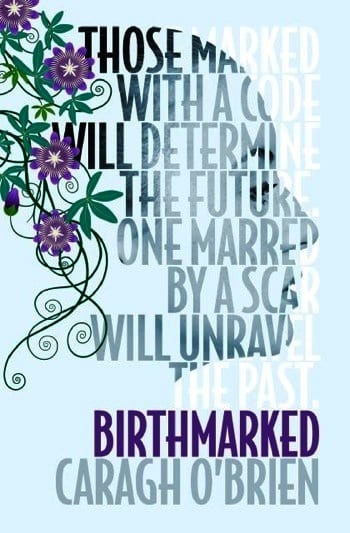
Birthmarked will have a different cover when Simon & Schuster Children’s Books UK releases the novel in the United Kingdom next May. I love how the profile is a visual game that draws me in, and how the words turn different colors as the meaning comes clear.  I find it delicate and strong, lovely and ominous all at once. Yes!
The Art of Neglecting

I’m here as a member of the club for anonymous people who neglect day-to-day things in favor of long-term projects like novels. As long as basic hygiene is covered, the rest is optional.

Take dishes, for example. Getting the kitchen completely clean once at the end of the day is good enough, quite frankly. For the third child, I learned it was actually an advantage to leave those dropped Cheerios under the high chair for a snack later. I do wrap up the garbage to make it harder for the mice to find their feast, but there’s no rush to water the cactus or fill the birdfeeder.

Writing Progress

And laundry?  I do it.  I just don’t fold it and put it away. My Nonna would tell me if I have to do a chore eventually, I might as well do it right away, but my Nonna never told me how to write a novel. Besides, I can pick through the clean laundry for what I need and skip the folding entirely. Problem solved.

In my defense, I’d like to clarify that I neglect things, not people. I’m quick to set aside my computer if a non-fictional person shows up in my living room. I like my family.  I even meet friends sometimes.

But the stuff? It can wait.

I have an inverse correlation theory about my clean laundry pile and my writing. The writing likes to secrete itself as invisible data in the computer, so it only shows up in a concrete manner about once a year as an unobtrusive volume on the mantel. Laundry, conversely, is egregiously, gigantically visible nearly every minute of the week. It is the absolute lowest item on my list of household bother to get to, far lower than getting groceries, answering the mail, staging holidays, writing thank you notes, or getting the cars in for maintenance. Folding means joyless work in a chilly room, so I’ll do anything else first.

In short, the more writing I do, the less laundry I fold, and vice versa. By this theory, I should look at my laundry pile and rejoice as it grows larger, for it is the visible evidence of time spent writing, and what would I really rather have done at the end of a year: my laundry or a novel?

Welcome to the club.

And incidentally, those copyedits I mentioned last week? I just sent them in today.

Favorite YA Reads of 2010

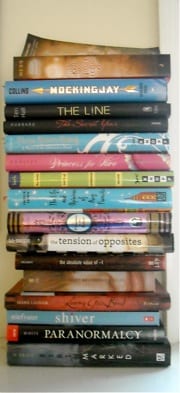
The Pile of 2010

I haven’t been reading much lately because it makes me want to write instead, which I do. I’m an aunt, though, and my husband and I staked out books as our gift-giving territory long ago. When I consider what to send our 23 nieces and nephews for Christmas, I start with the books I enjoyed myself. It’s especially fun this year because several other writers who debuted with me in 2010 (Ness and Collins are not debuts, of course) have become my friends.

Here are ten of my favorite Young Adult reads for 2010, in no particular order:

1. The Knife of Never Letting Go by Patrick Ness (“Ow? Todd?” Best talking dog)

2. Mistwood by Leah Cypess (A shape-shifter fights her amnesia)

3. The Line by Teri Hall (It bounces you back)

4. The Secret Year by Jennifer Hubbard (Secret love, grief, and a diary)

5. Three Rivers Rising by Jame Richards (A book-length poem experience)

6. Princess for Hire by Lindsey Leavitt (Much silliness. “Princess me up.”)

7. The Dark Days of Hamburger Halpin by Josh Berk (An endearing guy character)

8. The Life and Opinions of Amy Finawitz by Laura Toffler-Corrie (Snort out loud funny)

9. Prisoners in the Palace by Michaela MacColl (Neat historical tidbits of soon-to-be Queen Victoria)

10. Mockingjay by Suzanne Collins (Katniss brings it on)

Just thinking of them all makes me want to go on another reading binge.  Soon!

Behind the Scenes: Copyedits

I received my copyedits for Prized two weeks ago, along with marginalia from my editor.

A.Copyedits and Marginalia

We work with the Track Changes feature of Word at this point, and when I first received the manuscript, I shrank down the pages to get a general idea of how many comments I’d be dealing with (see Photo A).  The purple comments from Jill Freshney, the managing editor, have to do with formatting, so I largely ignore those. The green ones are from Suzette Costello, the copyeditor who, incidentally, also did the copyediting for Birthmarked and remembers things like Gaia’s customary gesture with her hair and points out where she’d be likely to do it again.  Amazing.  Suzette catches things like when I turn a cloak into a shawl, put a space in “anymore,” mix up the names of players on my teams, or say “boys turn into girls” when I really mean “girls turn into boys.”  She’s a mind reader with a very precise eye.  Her suggestions take little soul searching for me, and I almost always accept them.

B. Notes Up Close

The aqua comments are from Nan Mercado, my editor, and these are substantive. Though Nan and I have been discussing drafts of the novel since March, this is the first chance we’ve had for line-by-line feedback, and reading her notes in the margins is like having an extra voice along in my mind while I’m writing, a friend who pauses to call attention when anything could be clearer. She might say, “This line seems slightly out of character for the narration, no? It’s a direct statement about how Gaia is, instead of her state of mind at the moment,” or “I like how this will be echoed later in the scene with cadaver, but I’m not sure I believe that she would examine a corpse in this moment. She was so weak, why would that occur to her?” They tend to be open-ended questions that I could solve in any number of ways, and there are very few I disregard. Even then, I consider carefully before I make no change.

As I go, I keep in mind the broader comments Nan included in her accompanying letter, with feedback from her intern, too. Stacy Herman hasn’t read Birthmarked, so her fresh perspective helps me think about what might be missing for readers who come to Prized having no familiarity with the back-story.  Explaining old business requires a delicate balance because I dread boring returning readers with repetition, but I don’t want new readers lost.

The last thing I consider is another draft of my own that I kept revising while the book was ostensibly out of my hands. You can see it in the background of the screen (see Photo B). That tinkering gets merged into this draft, too, and I need to make sure it is scrupulously clean because the book is now post-copyedits. How awful it would be to throw in extra errors at this point.

C. After Folding in Copyedits, etc.


Here’s what the manuscript looks like once I’ve made my changes (see Photo C).  You maybe can’t see it, but the red indicates new changes in the text, and I deleted the comments from the margins as I went, leaving only a few that I’m still pondering.  I have about sixty pages left to go, so I’ll be done in a couple days, but I’d like to take one more chance to read through the whole thing at normal speed, just to make sure it all works.

In case you can’t tell: I love this part of the process.  I could not do it without Jill, Suzette, Nan and Stacy.  Never think my novel is the work of one person.

Q. How’s Your Book Doing?

A. Now and then I wonder that myself.  I can always call up my editor and ask, but the sales numbers don’t mean much to me since I have nothing to compare them to, so I end up calling my agent for an interpretation.  He tells me not to worry, the numbers are “strong,” and since I trust his expertise, I find this reassuring. Even so, I suspect I’m not alone in wishing I had a better ball-park understanding of what goes on with young adult debuts, so I dug around for some basic data.

A. Bestseller YA Debut (NovelRank)

We all know statistics can be misleading, especially when you have a small sampling of a large unknown pool, but why let that stop us?  How a novel sells on Amazon.com is, I’ve heard, anywhere from 5-20% of the novel’s total sales, so that information on its own is not very useful.  NovelRank.com, a free, public site, takes the frequently updated “Amazon Bestsellers Rank” data from Amazon.com and charts it in long-term graphs.  Now it starts getting kind of fun.

Here’s a graph (A) of a debut young adult novel that was a bestseller the first week it was released, at the end of August.  It’s been selling well over 200 copies a month on Amazon for the last four months, and it pre-sold a lot before it was even released.  Don’t be deceived about the December drop-off: we’re only two days into the month.

B. More Typical YA Debut? (NovelRank)

Then there’s a graph (B) of a different debut young adult novel that came out in March, like mine.  It sold well over 100 copies on Amazon at its peak and is still selling, but closer to 30 per month.  I’ve seen half a dozen similar graphs for debut YA novels—a tiny sampling—just enough for me to not get bored and to guess this is a more typical curve.  Please remember, I’m totally not an expert on this.

Finally, here’s a graph (C) for Birthmarked, also a debut young adult novel, which was released the last day in March.  NovelRank started following it April 2, when I first discovered the site and entered the title for tracking.  Its highest bump shows just over 100 books sold on Amazon in May.  It had a drop in August, picked up again in September when school started, and has been fairly steady in the 70’s since.

C. Birthmarked (NovelRank)

I already knew my book was no bestseller, but it also looks like it’s doing as well or better than debuts usually do, at least on Amazon.  I think it’s early yet to know how it might do long term, but “strong” for now seems pretty good to me.

By now you’re probably wondering why I don’t just consult my royalty statement. I will, when I get one.  Then I’ll probably have to dig up some basics so I’ll have something to compare it to.

As always, feel free to comment.  I’m sure there are people out there who know more about this than I do.

Audio Books
The audio books of BIRTHMARKED, PRIZED, and PROMISED have been released by Tantor Audio. They're available through Tantor, Barnes & Noble, Amazon, and Audible.com
Blogger Roadsign