Archive for November 2010
Full
Can I just admit I’m still full
from Thanksgiving dinner four days ago?
Maybe eating pie for every meal since
hasn’t helped. So far, my most significant salvo
for attacking the stuffed feeling has been to stop
getting on my scale.
But as of now, as soon as I post this,
I am going to go take a walk.
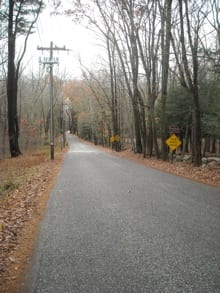
About a mile from my house, down
a quiet, scenic road with speed bumps,
(lest I move too quickly),
stands my favorite stop sign.
I walk to it most days and touch the seven
o’clock corner of the octagon for luck.
I listen to my iPod, keep my hands in my pockets
and sometimes I see a guy with a three-legged dog.
I’m not fooling myself. This is not true
exercise like playing squash or lifting weights.
I have really nothing profound to say about it
whatsoever.
I’m going to take a walk.

Good Luck
How to Raise Reading and Writing Test Scores
As an English teacher who has recently resigned, I’m no expert, but here’s my plan to raise reading and writing tests scores in middle school and high school.
1. Do not require English teachers to attend any seminars, presentations, or meetings on how to increase reading and writing test scores.
2. Do not put the poor readers and writers all together in the same class.
3. Do not require English teachers to write reflections in which they analyze students’ scores on 45-minute writing assessments taken at the beginning, middle, and end of the semester and explain what they did to affect those scores.

American Lit Grading, One Section
4. Do not require English teachers to write the objective of the day’s lesson on the board before each class.
5. Do not, on the first professional development day after summer vacation, when the teachers are well rested, inspired and excited, have the superintendent present the district’s test scores from the previous year along with scores of other districts that did better.
6. Do not make students take practice tests.
7. Do not purchase an “artificial intelligence” computer service for students which provides writing prompts, gives students a score for their grammar, spelling, and punctuation, alerts you if they use the word “suicide” in their writing, and makes the average score of your students’ work available to administration to compare with other classes.
8. Do not, each year, require English teachers to write new curriculum, or new common final exams, or new rubrics for alternative assignments for students who do not meet goal on their standardized tests yet need to meet graduation requirements.
9. Do not make teachers look up the previous test scores of their current students to look for a pattern of which state curriculum standards the students did not master.
10. Cap English classes at twenty.
11. Establish independent reading for half an hour every Friday, with no assessments connected.
12. Have an online page for the school library where students can post reviews of their favorite books and comment on one another’s reviews.
13. Put big comfy chairs in the school library and make sure the library isn’t closed a block of each day because of a staff shortage.
14. Let the students pick at least one of the books the class will study as a whole group by discussing length, subject matter, age and gender of the protagonist, covers, or anything else they think matters.
15. Let students choose their own writing topics and genres to express their ideas.
16. Allow students to have water bottles in class and to leave for the bathroom when they need to go.
17. Invite journalists, novelists, screenplay writers, poets, public library librarians, human rights activists, artists, and storytellers to visit classes and compensate them for their time.
18. Eliminate standardized tests altogether.
Results:
With the enormous amount of time saved, teachers and students will be able to concentrate on true learning. Morale will sky-rocket. The test generating and scoring companies will go out of business. Vast amounts of money will be saved. Best of all, we will reclaim the dignity and enthusiasm that are the rights of every student and teacher.
Killing Them Off
My friend Jenn Hubbard recently posted about the reader-writer contract, and how a promise is delivered to a reader within the opening sentences of a novel. It reminded me of another contract I’ve been pondering, the kids’ books one that promises not to kill off major characters.
The End of the Road
Wait. No. What makes me think such a promise even exists to break? I read White’s Charlotte’s Web when I was too young to question what was happening, and while I was heartbroken about Charlotte, I didn’t feel any particular, personal sense of betrayal. Possibly it mattered that Charlotte was old, and her death seemed natural. It was one of my first books ever, a seminal reading experience that should have been a basis for any patterns I began to recognize later. Yet, when I read Paterson’s Bridge to Terabithia for the first time as an adult, I was devastated. Not only did the loss wring me out, but I also felt like the rules had been violated. In the years between White and Paterson, I’d absorbed that deaths weren’t supposed to happen to people I cared about in kids’ books. I’d imagined a promise that, once broken, could never be trusted again, and that unglued me. Since death could happen to my friends in kids’ lit, there was nowhere safe left to go. I never wanted to read anything again.
No, truly. I never wanted to read anything ever again. Certainly not a kid’s book with engaging, imaginative characters.
But I did. Eventually.
Now I’m feeling squeamish. I’d love the power of killing off a key player in my next novel and realistically, it could happen in the setting I’m working with. But I just feel like it would be wrong, with a capital “W.” In the past, stuff that felt Wrong has led me to my most disturbing discoveries as a writer, discoveries that have rippled into my real life as a person. But do I want to go there with death?
The worst thing of all, I think, would be to use death opportunistically, just for shock value, just because a writer could. That would be mean and unfair, not only to the reader, but to the stories that have truly earned their meaningful deaths. Like Charlotte’s. It’s safer to avoid it completely than risk being cheap.
Why do I even need to grapple with this? I resist, squirming. I’m nowhere near the scene, yet, where this could happen, so there’s no need yet to prepare. I’m fully aware, too, that I’ve already had some pretty awful deaths in my writing, so this isn’t completely new territory. Those deaths had to be there and I didn’t question that they did.
But certain deaths. I don’t know. They would be Wrong. Wouldn’t they?
Beauty Surrounds Me
My lunch apple today was just gorgeous, glowing and powerful, so much that I had to just stare at it before I could cut into it. I am surrounded by beauty.
I have this theory about sensory detail and reading. Since normal intake of our world reaches our brains through our five senses, if a writer can describe things clearly enough that a reader sees, smells, hears, tastes and feels them, then the words on the page have co-opted the brain. It’s a polite form of mind control, and if you’ve ever been jarred out of a book because some one calls you to dinner, or to feed the baby, then you know what I mean.
I’ve done this to students when we’re studying setting. I say, imagine you’re walking barefoot down a wide public beach in the day time, with the colorful beach umbrellas, the regular crash of the waves coming in, the smell of coconut sun lotion, and the seagull with the orange beak flying overhead crying out a squawk. Someone hands you a chocolate ice cream cone that tastes half melted already.
Now imagine the same beach at night, and you’re walking towards a bonfire. The people are gone except for a few who are laughing, silhouetted by the fire, and there’s just enough moonlight that you can see the edge of foam where the waves come in. The wet sand is cold under your feet, and as you get closer, you can smell wood smoke. Someone hands you a marshmallow, perfectly toasted, and you have to lick when it sticks to your fingers.
Now imagine the same beach at night, but now it’s winter and the fire is gone. So are the people, and your coat isn’t quite warm enough. You still don’t have shoes, so you hurry over the sand. The waves are louder now, with a sucking sound, and the foam edge of the water is barely visible. Then you look up to see it’s starting to snow big, fat flakes that glow blue in the moonlight.
If it works, you’re seeing snow over a beach, by moonlight. Never mind that it should be impossible to see snow by moonlight if there are enough clouds for it to snow.
How does this work? I just max out the sensory details in the descriptions. It’s one of my favorite, favorite parts of writing.
Today, I’m at a point in Book 3 where I don’t know what’s about to happen, but I can see the scene Gaia sees, and hear it and feel it, so if I try hard enough, I can just go there with her and let time go by, and a story will unfold. It’s a first draft. It’s supposed to be fun, so here goes.
Veterans Day
My novel is dedicated in memory of my father, Thomond R. O’Brien, Sr., who served honorably as a cryptanalyst in the United States Army in Germany in the 1950’s. On this Veterans Day, I’d like to honor my dad, and all our veterans and the active military personnel who now serve our country. We would not be here today without you, and I’m grateful.
Tolland Public Library
I’ve been invited to speak in the Eaton-Dimock-King Authors Series at the Tolland Public Library tonight, November 10th, at 7:30. The event is free, but space is limited, so please call to register if you’d like to come. 860-871-3620.
The Terror and the Trust of Not Outlining
I’m a seat-of-the-pantser. I’ve done books using an outline before when I plotted out romances in ten chapters (major intimacy in Chapter 7) so I know it’s possible, but that is not how I wrote Birthmarked, and it is not working for the sequels. The main problem is that I have to be in the scene, imagining it, in order to live where it’s going with Gaia. Since she can’t see into the future, neither can I. If the reader is to be surprised, I must be, too. But that’s a bit of a cop-out. The truth is that I don’t outline for Gaia because I just can’t. My mind isn’t working that way. I have an idea of one scene I’m heading towards with Book 3, like I had a scene I was writing toward with Birthmarked, but it’s still very open-ended, and I like the comfort of knowing it could go anywhere. Uncertainty helps me be creative.

Seat-of-the-Pantsing
Uncertainty is also terrifying, because I’ll go in plenty of wrong directions before I find what will work. I’ve just had a rather torturous experience writing Prized, where the first draft was 450 unwieldy pages long. For months, I kindly referred to it as “dog rot.” Yet I had to write it to discover what was going on. Nine drafts later, after lopping off 50-page sections left and right and writing dozens of new scenes, the novel now has a tight plot, and I’m so happy with it that I relish the minute tinkering of the line-by-line and can hardly bear to give that up in order to work on the next book.
It has been gently suggested to me that perhaps I could write a short first draft of Book 3 just to get the blocks in place before I embellish. Believe me. I’d love to. I think it will help that I’m writing full-time now, and not trying to keep the mental continuity going over 25-minute lunch breaks. But I also know that I just have to write a first draft, whatever its messy length, because once I get to the end, I’ll be able to see the entire arc of the story, with all its surprises and holes. I trust that this seat-of-the-pants, butt-on-the-couch process will work for me.
Just for kicks, here’s an example of how the opening of Prized changed. In the first draft, the opening lines were as follows:
The infant took two weak, reflexive sucks on the bottle, and then her lips went slack. Gaia shifted closer to the firelight and watched the baby’s chest for the swell that would confirm she was still breathing.
Bad news, but quiet. Seven months and five drafts later, the opening became this:
She grabbed the hilt of her knife and scrambled backward into the darkness, holding the baby close in her other arm. Beyond the fire, the wasteland was still, as if the wind and even the stones had frozen in the night to listen, and then she heard it again, a soft chink that could be metal or a boot adjusting against pebbles.
Outlining, obviously, has nothing to do with how I write. Thank goodness.


During recess, while the other kids of his year were playing on the swings and the jungle gym, and the big kids were playing soccer on the grass area that had not burned, Pyrho quietly passed back inside the building, down the dim, deserted hallway, and out the janitor’s door.