Novel Promised Book Cover
About Birthmarked: "This science fiction adventure is a brisk and sometimes provocative read, thanks to solid pacing, a resourceful heroine, and a few surprise twists."

--Publishers Weekly

FBsquareTwitterSquareFBsquare

Archive for October 2010

Q. Do You Read Reviews of Your Book?

A. Not normally.  I notice they’re out there.  If I see a review has 5 stars or a raving first line, I might read it.  Anything less, and I look away.

I learned this the hard way.  I wish it weren’t the case that strangers’ opinions have any power over me, but they do, so back when Birthmarked first came out, when I read a few bad reviews, they stung.  For days.  Even an otherwise very nice review could include a zinger about the unresolved ending, or the so-so world-building, or the soap-opera-esque drama, and that would be all I saw.

Who needs that?  It’s hard enough to write at all without adding in extra negative voices.  Don’t get me wrong: I’m all for people reviewing books honestly.  It means they care, and they read, and they’re in the great discussion of books.  I just know, to protect myself, that I shouldn’t read reviews of my book.  So I don’t.

Iceland Volcano April 17, 2010

I do, on the other hand, read emails, because so far only polite people who like the book have bothered to email me.  I recently received one from a girl who hates to read and normally puts down a book after one page, but Birthmarked was keeping her up late.  That means a lot to me.  There was one from a girl who was stranded in Europe after the volcano eruption in Iceland closed down the airports, and reading Gaia’s story distracted her from being stressed and lonely while she waited to come home.  There have been emails from librarians, teachers, and booksellers who really know their stuff, and the one from a grandmother whose granddaughter loaned it to her when she saw she needed something to read.  A book group in Indonesia wrote to me and sent a photo.  People post kind things on my Facebook writer page, too, often the minute they finish reading the book.  Those are really fun.

Like I said: strangers’ opinions matter to me.  I just pick which strangers I listen to, and those are the ones I think about while I’m writing the next book.  I really hope they’ll like it.

Gaia’s Voice

Nan Mercado, my editor, asked me the other day how I came up with Gaia’s voice and how I developed it, and I had no idea how to answer her.  What’s strange is that I know Gaia inside and out.  I know her personality, and how she talks, acts, and thinks.  Her belongings have history.  How she perceives her world and how that changes are all part of her, too.  I know her so completely that when I wrote a little story about Gaia at age eleven last week, the younger version of Gaia appeared to me whole and ready to go, entirely consistent with the more mature version in Birthmarked.

Yet knowing a character completely is not the same thing as knowing how I came up with her voice, let alone how I developed it, so I’ve been pondering this.  It’s hard for me to isolate her voice from her behavior or gestures, as if it were coming at me over a phone line.  Voice, I realize, isn’t just what Gaia says and how she says it, although there are words that have sounded wrong from her so I’ve changed them.  It’s also what she thinks, and the gap between what she thinks and what she says.  It’s what she doesn’t say.

Writing in third person, as I did for Birthmarked, doesn’t allow for many opportunities to deliver Gaia’s thoughts directly.  I did, occasionally, with italics, but italics risk being distracting, especially if they’re too frequent.  I’m looking at a passage here and I see that what I did instead was give Gaia’s reactions, and when they’re important, her feelings.  I don’t usually notice this when I’m writing, because it’s all mixed in with imagining the scene, but take a look.

Here’s a passage from Chapter Two, when Sgt. Grey is examining the satchel Gaia keeps her midwifery supplies in:

He then turned the satchel inside out and examined the cloth, every seam and ripple of the brown, gray and white fabric.  Gaia’s father had lovingly sewn each stitch, making a thing of beauty as well as a strong, practical bag that fit comfortably over Gaia’s shoulder.  She felt like the satchel was part of her, and watching Sgt. Grey’s examination of the cloth and its contents felt like a keen violation of her privacy, all the more because his fingers were meticulous and careful in their movements.

His hands stilled on the cloth and he looked over at her finally, his expression neutral.  She couldn’t tell if he was relieved or disappointed.

“You’re young,” he said.

His comment surprised her, and she saw no reason to answer.  Besides, she could say the same thing to him.  He straightened, then exhaled with a sigh and started putting her things back in the satchel.

“It’s okay,” she said, stepping forward to the table.  “I’ll do it.  I need to clean my things anyway.”

She hardly says anything, but she’s vulnerable and watching intently so we know what she’s thinking.  There’s a pleasing little mental turn in the word “Besides.”  Around that word, we get to see her mind move from surprise, to privacy, to a sort of annoyance, and then when she finally speaks, the only thing she reveals is her competence.

I’m afraid what I’ve discovered is that I can’t separate voice from the rest of the way I write.  It’s completely enmeshed with character, scene, and plot.  I’d be curious to know what other writers think about voice.

The Genetic Freedom Act

The law isn’t really called that, but since I’m already playing with fiction twists, changing the name is a satisfying place to start.  The Genetic Information Nondiscrimination Act of 2008 says about what you might expect it would: that insurance companies and employers can’t discriminate against anyone because of his or her genes.  They can’t demand genetic info about people, or their families, when they’re deciding whom not to cover in policies or whom to employ.  That’s the real law here in the U.S.

It’s just too tempting, isn’t it?

A-DNA, B-DNA, and Z-DNA

Imagine the reverse: that people have to register their DNA before they can work, vote, marry, or enter a hospital.  Imagine if, at the airport, while you’re taking off your shoes and exposing your personal effects to get through security, you also have to give a drop of blood so they can clear you in the genetic database.  Better still, suppose you have a child who is genetically desirable, and the government wants your kid to experiment on while they try to find a cure for hemophilia, or sickle cell anemia, or cancer.  Some wickedly awful fiction could happen.

I’m not personally worried about people knowing my genes.  Neither are the “PGP-10,” George Church and nine fellow scientists who released their personal genetic and medical data to the public as they launched the Personal Genome Project in 2008.  Over a thousand volunteers have now contributed their info to the project in the belief that doing so could  “promote human welfare through the advancement of scientific and medical discovery” (personalgenomes.org).  I wonder if it’s a coincidence that the PGP-10′s personal data went online just a few months after the Genetic Freedom Act was passed.

So, as I consider ideas for Book 3 in the Birthmarked trilogy, I can’t help noticing I’ll be playing on people’s fears about genetic discrimination, and possibly even adding to the misconceptions about how genes can be used for evil.  But I give myself permission anyway, because I don’t think it’s genetic information itself that is the danger: it’s uncontrolled, corrupt government that’s the danger.

And in real life, we’re safe from that.  So far.

Gaia at Eleven

(Here’s a bit story about a character from Birthmarked when she was a kid.)

Gaia plugged the last jug with its stopper and tied the handle to the end of her pole.  Once more, she tested the grip of the faucet in the great wall to be certain it was off tightly.  Spilled water had absorbed into the dust already, making it a richer brown, and she messed her bare toes into it for the coolness before she lifted her yoke pole and balanced it over her shoulders.  With two water jugs on each end, she could have taken more weight, she knew, but her father didn’t want her carrying more.  “Bad for your back,” he’d said.  It only meant she had to make more frequent trips.

She turned towards the path that dipped back down into Wharfton, feeling the weight of the water give the pole a heavy, slow-motion balance all its own.  She liked the pleasing proof that she did her share for her family now that she was growing.  Low, early sunlight streamed in sideways from her left, and though she wanted to tip her hat to keep it off her scarred cheek, it would have meant setting her water pole down again to have a free hand, so she bent her face low.

She didn’t see the older boys coming up the path until it was too late to sidestep them.

“I believe it’s little Gaia,” Ralph said, and he set the tip of his pole directly in her path, compelling her to stop.

There were two other boys as well, both as dirty as Ralph, and burdened with over a dozen empty jugs.  She knew their families from the other side of Western Sector Three, but she’d never talked to them much.  She’d never wanted to.  The other two spread out on either side of Ralph, and their poles made a crisscross pattern around them.  The shortest one had a couple teeth missing in front when he smiled.

“Get out of my way, Ralph,” she said.

“What’s your hurry?” Ralph said.  He lifted his pole, but only to give one of Gaia’s water jugs a nudge.  She had to swivel heavily to keep her balance.

“Don’t,” she said, but she was getting scared.

“How’s your scar?” Ralph said, flicking a finger at her.  “I heard sunlight’s bad for scars.”

She stepped off the path to try to go around them, but Ralph only maneuvered his pole to block her feet again.

“Don’t leave us,” Ralph said.  “We’re just trying to make friends.  It looks like you need a hand with your hat there.”

“Don’t touch me,” she said.

Ralph laughed.  “I’m just trying to help.  You’re so sensitive.”

When he came a step nearer, she rolled her pole off her shoulders to set down the water, and put up her fists.  She was trembling and she’d never felt so small.  “I don’t want your help,” she said. “And I’m not sensitive.”

The other boys laughed.

“You going to fight a little girl, Ralph?” the gap-toothed boy said.

“This isn’t a fight,” Ralph said.  Then he frowned at Gaia.  “You’d be pretty if you smiled more.”

“And you wouldn’t stink if you washed more,” Gaia said.

The two other boys laughed again, and the taller one started on up the path towards the wall.  “Let’s go, Ralph.  Leave the warp-face and come on.”

The gap-toothed boy also moved around Ralph to continue onward, but Ralph leaned down for a little yellow flower in the grass and picked it.  He twirled it idly, looking at Gaia, and still his yoke pole waited beside her feet, ready to trip her.

“I could have liked you, you know,” he said to Gaia.  “It’s not too late.”

She shook her head.

“Just say please and I’ll move it,” he said.

She looked down at the pole, where the end lodged in the dry, spiky grass.  Even the rope tied at the end was dirty, fraying, like nobody in his family cared about such details.  She met his gaze again and beamed all her hatred at him.  It made her feel stronger, this anger.

“No,” she said.

Slowly Ralph pulled his pole away from Gaia’s feet.  “Just to be clear,” he said, “the mean one here was you.”

He flicked the yellow flower past her face and walked backward up the path, still watching her.  She jammed her hat lower on her head and reached for her pole.  Relief was making her shake worse than her fear had, but she didn’t feel like she’d won exactly.  It took her forever to get her yoke pole balanced right again on her shoulders, and even as she  started down the path again, she knew she’d have to come back for more water the next day.

The important part was going to be not telling her parents, so they wouldn’t prevent her.

Afterward, We Ate

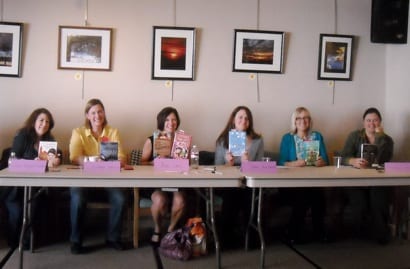
Laura Toffler-Corrie, Caragh O'Brien, Ann Haywood Leal, Jame Richards, Sari Bodi, and Michaela MacColl

Yesterday, I met up with Laura Toffler-Corrie, Ann Haywood Leal, Jame Richards, Sari Bodi, and Michaela MacColl for a panel at the Ridgefield Library in lovely Ridgefield, CT.  The local kids were painting Halloween pictures on the local businesses and there were balloons everywhere, so it was a fun day on Main Street.  About forty people came by to hear a bit of advice on writing and publishing, and then asked questions.  I liked finding out there were other loner writers in the audience, the types who, like me, avoid writers’ groups.

Afterward, we dined at Fifty Coins Restaurant, and I discovered there’s such a thing as cranberry mayonaise.  Who’d have guessed?

Many thanks to Laura Toffler-Corrie for setting it up!

Kids Lit Panel

I’m joining my friend Laura Toffler-Corrie and four other YA and MG writers at the Ridgefield, CT library this coming Saturday for a writers’ panel from 1:00-3:00.  We’re ostensibly dispensing advice on the writing and selling of children’s books, but I suspect we’ll digress.  I, for one, am far from an expert.  Maybe I’ll get the easy questions, like what to do if your fingers get cold all the time when you’re typing.

Behind the Scenes: A Query Letter

In May, 2008, I wrote to three dozen literary agents to see if any of them would be interested in taking on Birthmarked, then called The Baby Quota.  Here’s my initial email correspondence with Kirby Kim, who now represents me.

Dear Mr. Kim:

In a dystopian future, the world is divided between those who live inside the wall, and those, like sixteen-year-old midwife Gaia Stone, who live outside.  It’s Gaia’s job to turn over her quota of infants to the authorities within the wall, until the night one agonized mother objects, and Gaia’s own mother disappears.  Fraught with difficult choices that propel Gaia further and further within the confines of the wall, to the prison and even to the Bastion where the Protectorate lives with his privileged family, THE BABY QUOTA is the riveting story of a girl who wants to save her mother, and a society where a criminal is defined by her genes.

THE BABY QUOTA is an edgy young adult novel of 70,000 words, suitable for mature high school readers.  I understand that you represent young adult fiction, and I believe my novel has the intensity that would appeal to readers who enjoy the works of Ray Bradbury and Laurie Halse Anderson. 

Since I earned my MA in the Writing Seminars at Johns Hopkins University, I have published six category romance novels with Silhouette, Bantam, Avalon, and Kensington.  I have also published a handful of parenting articles for The Hartford Courant.  Though I’m on leave this semester, I normally teach at Tolland High School, in Connecticut, where teenagers are a daily part of my life, and I have three teenage children of my own. THE BABY QUOTA is my first young adult novel.

I’m including a brief summary of the novel below.  If you would care to see the complete manuscript, please let me know.  Thank you in advance for your consideration of my project, and I look forward to hearing from you.

Sincerely,

Caragh M. O’Brien

Yosemite, June 2008

That’s cute about Bradbury and Anderson, right?  How often do you see those two authors in the same sentence?  Kirby must have thought I was something else.  He replied the next day in what I would later discover was his typical timeliness.

Hi Caragh,

This sounds very interesting. Although I just sold something similar I’d be interested in taking a look. Please attach to an email at your earliest convenience.

Best,

Kirby Kim

By June, when my family was driving back to Connecticut via Yosemite, I had four offers of representation and began to believe my novel might have a chance of being published.

Tale of Two Covers

In the spirit of Frankfurt and the Book Fair this week, here’s a curious tale of translation for covers.  When the German translation of Birthmarked popped up on Goodreads, I was delighted to see the cover was a striking and mysterious image of two vivid profiles over a dark background.  I went right to an online translator to find that the new title “die stadt der verschwundenen kinder” meant roughly “The City of the Missing/Vanished Children,” and I was like “Oooh, that’s cool.”  It all fit my novel in a whole new way.

Cover of Glimmerglass in the U.S.

Imagine my surprise when a Facebook friend pointed out that she knew the cover already: it belonged to Glimmerglass by Jenna Black.  Sure enough, they were the same except for mine was a mirror image of the other.

German cover of Birthmarked

I asked my agent to check on the situation, and the upshot is that my German publisher, Heyne, liked the Glimmerglass cover so much that it bought the exclusive rights to the art and the design to use in Germany.  It’s legal, if not commonly done, and since it would have been far more economical for Heyne to do a cover in-house, the purchase of expensive rights shows the publisher’s commitment to the book.  The translation of Glimmerglass will have a different cover in Germany, incidentally.

It was kind of an odd feeling, at first, having a second-hand cover, though I’m used to it now.  I couldn’t help wondering if people would secretly snarl and think I stole something, when in fact the rights were fairly bought.  I sometimes fear that Germans might pick up my book, hoping it’s Jenna Black’s, only to be disappointed that it’s not.  Sometimes I wonder why a pale, distinctly Caucasian, beautiful, blue-eyed girl is on the cover when Gaia is of mixed heritage, unremarkable in terms of beauty, and brown-eyed.  Then I think of the ideas of genetic merit in the book, and the history Germany has with a scary society that valued certain people over others, and I think it’s actually a pretty gutsy cover.  In the end, I’m grateful my German publisher is so deeply invested in my book, from the inside translation to the outside cover.

Life is strange.  So is publishing.

Audio Books
The audio books of BIRTHMARKED, PRIZED, and PROMISED have been released by Tantor Audio. They're available through Tantor, Barnes & Noble, Amazon, and Audible.com
Blogger Roadsign